So you’re testing for accessibility with axe: fantastic! As your accessibility practice grows and matures, there may come a time when you outgrow the free axe tools and need something more suitable for enterprise application development. We know because we hear about this process a lot from our customers. To help inform your team as you select a suite of accessibility testing tools, let’s discuss the reasons you might need to upgrade to WorldSpace Attest.
The free axe tools include browser extensions for Chrome and Firefox, open source testing APIs for JavaScript, Ruby, and Java, as well as an open source command-line interface, axe-cli. For many developers and testers, these tools can get the job done. However, there comes a time when teams need to move beyond the free tools to foster better collaboration and organizational efficiency. At that point, it may make more sense to select one or more of Deque’s tools from the WorldSpace product line. Which tools you need will depend on who is doing the testing, and what you hope to gain by purchasing a testing product.
WorldSpace currently consists of three major products built and maintained by Deque: Attest, Assure, and Comply. Each product allows for specialized testing across various phases of the software development life cycle, or SDLC. All three products are built on top of our open source axe-core testing engine, with more sophisticated controls added for ruleset configuration and versioning.
Software developers can integrate WorldSpace Attest’s automated accessibility testing APIs into their projects to highlight common accessibility problems early and prevent them from making it to production. For both general QA and specialized accessibility testers, WorldSpace Assure provides interactive testing, going beyond what can be automated. For ongoing monitoring of deployed projects, WorldSpace Comply can spider your website or web application and provide a dashboard of accessibility test scores over time.
Along with our customers, we use multiple products under the WorldSpace umbrella internally for our own accessibility testing processes, providing ample feedback for bug fixes and general improvements. Our team of amazing accessibility subject matter experts, including colleagues with disabilities, use our tools much in the same way Google employees would utilize Gmail or Hangouts (so-called dogfooding). It’s an important part of our product development process.
Why WorldSpace Attest?
Custom rules
To get back to our initial question, when would you start to require something like WorldSpace Attest for accessibility testing? The most common scenario is managing accessibility standards across an organization, including custom rule functions and impact levels. The free axe extension simply wasn’t designed for this purpose.
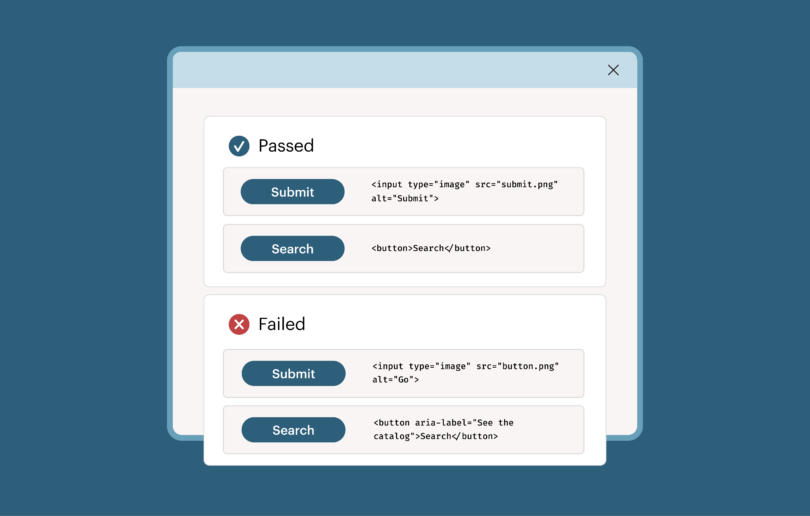
For example, does your organization use WCAG 2.0 AA but specifically disallow use of aria-label for UI controls? How about changing the impact level of a rule or two in axe-core, or disallowing bad practices? If you wanted to enforce these policies across multiple teams and member roles, you’d have a rough time syncing them without an enterprise accessibility testing solution.
Another very powerful thing is to write rules for your UI component or pattern library. The more you know about your specific test environment, the more you can automate for accessibility. We’ve seen an organization catch 2/3rd of all their issues with axe and custom rules, while axe alone can rarely get you more than 1/3rd. That’s double the coverage with well-designed custom rules.
Developers using WorldSpace Attest would not only be able to share the same ruleset configuration across extension installations and automated tests; but also with WorldSpace Comply, making results more consistent across the two products. Sharing configurations means everybody tests against the same standard, even if they have different roles, for example in development, QA or project management.
Attest Devtools extension
Our free axe Chrome extension is one of the world’s most popular accessibility testing tools, with over 48,000 weekly users. But for many teams, they outgrow it when they can’t export or share issues with other members of their team. Issue export is a premium feature in our Attest Developer Tools extension–with over 150,000 weekly users of its own–which comes as part of the WorldSpace Attest product line.
Attest Devtools also interfaces with WorldSpace Comply, allowing team members to upload issues found in development and download issues from automated spider scans. We recently added an extension feature to select a specific axe-core version, making it more straightforward to manage results across multiple products. Read more about this new feature in our last WorldSpace Attest blog post.
Sharing reports
Attest can generate reports for teams to share with each other and with leadership. You can export issues from the Attest Devtools extension in JSON format, and/or use the Attest reporter to generate HTML reports. Attest also integrates with code quality dashboards like SonarQube** and we have some exciting new features planned to even further improve the reporting capabilities.
Controlling the axe-core version
Although configurable through the axe.configure API, the axe-core JavaScript engine is pretty tightly coupled with its default set of rules (by design). We publish new axe-core versions to add new rules and fix bugs, sometimes specifically in response to client needs. For consumers of our free software, you can’t really control the flow of rule updates in browser extensions or development APIs without turning off automatic updates or locking in a version in your dev environment. One major benefit of WorldSpace Attest, for example, is the ability to install custom rulesets independent of the core engine with ease. This provides more predictable accessibility test results that large teams can rely on.
Better APIs
The free and open source APIs for Java, Ruby and JavaScript provide basic features for free but we find that Enterprise customers want richer API sets and more features. Our Attest APIs provide more functionality (like support for the common reporting format) as well as better APIs, including a Hamcrest matchers Java API, pre-built Gherkin (Cucumber) steps (for Java and Ruby) and easier ways of configuring the API to use custom rules and pre-built rulesets.
More integrations
We’ve developed additional test integrations that are only available with an Attest license. WorldSpace Attest is also a high-quality accessibility testing tool for native iOS and Android. Our codeless testing solution, Attest Getter (AGet), is great for teams who don’t already have test coverage in their applications. These tools can all be configured to share custom rulesets where applicable.
Product support
Finally, one other perk of WorldSpace Attest is getting ongoing support from the product team. Should your team members need extra clarification or support for an issue, we’re just a helpdesk ticket away.
**SonarQube has removed essential components that are integral to the function of the Attest SonarQube Plugin. Deque has no plans to rework the SonarQube Plugin in the foreseeable future. As of July 23, 2019, Deque will no longer distribute or provide support for the Attest SonarQube Plugin