Will AI be our savior or our downfall? It’s a question everyone seems to be asking, and opinions differ wildly.
At one extreme, you’ve got claims that AI will perform every task that needs doing, creating wealth, replacing work, nurturing a new leisure class, solving all our pesky global problems, and essentially saving the human race. At the other end of the spectrum, you’ve got a very different AI reality: one where models regularly hallucinate, fail at seemingly basic tasks, and provide dangerously erroneous information.
At Deque, my colleagues and I are taking a responsible, human-centric approach to AI, and we’re excited about its power to drive accessibility innovation. In a recent post introducing some new features, my colleague Harris Schneiderman explained AI’s importance to digital accessibility:
“To solve AI-created accessibility challenges, you need AI-powered accessibility solutions, and that’s exactly what Deque is providing.”
The reality is that AI adoption is accelerating so rapidly that companies can’t build data centers fast enough to keep up. What used to take ten developers an entire day can now be done by one developer in an hour.
However, when things like privacy, security, and accessibility aren’t integrated into workflows, products and services are far more likely to ship with serious issues. Which means legal risk goes up. Way up.
Digital accessibility has long existed in an environment of complaints, demand letters, litigation, and settlements. Some of this activity is strategic—lawsuits designed to encourage businesses to get and stay accessible. Other actions are predatory: “drive-by” lawsuits designed to force quick cash settlements.
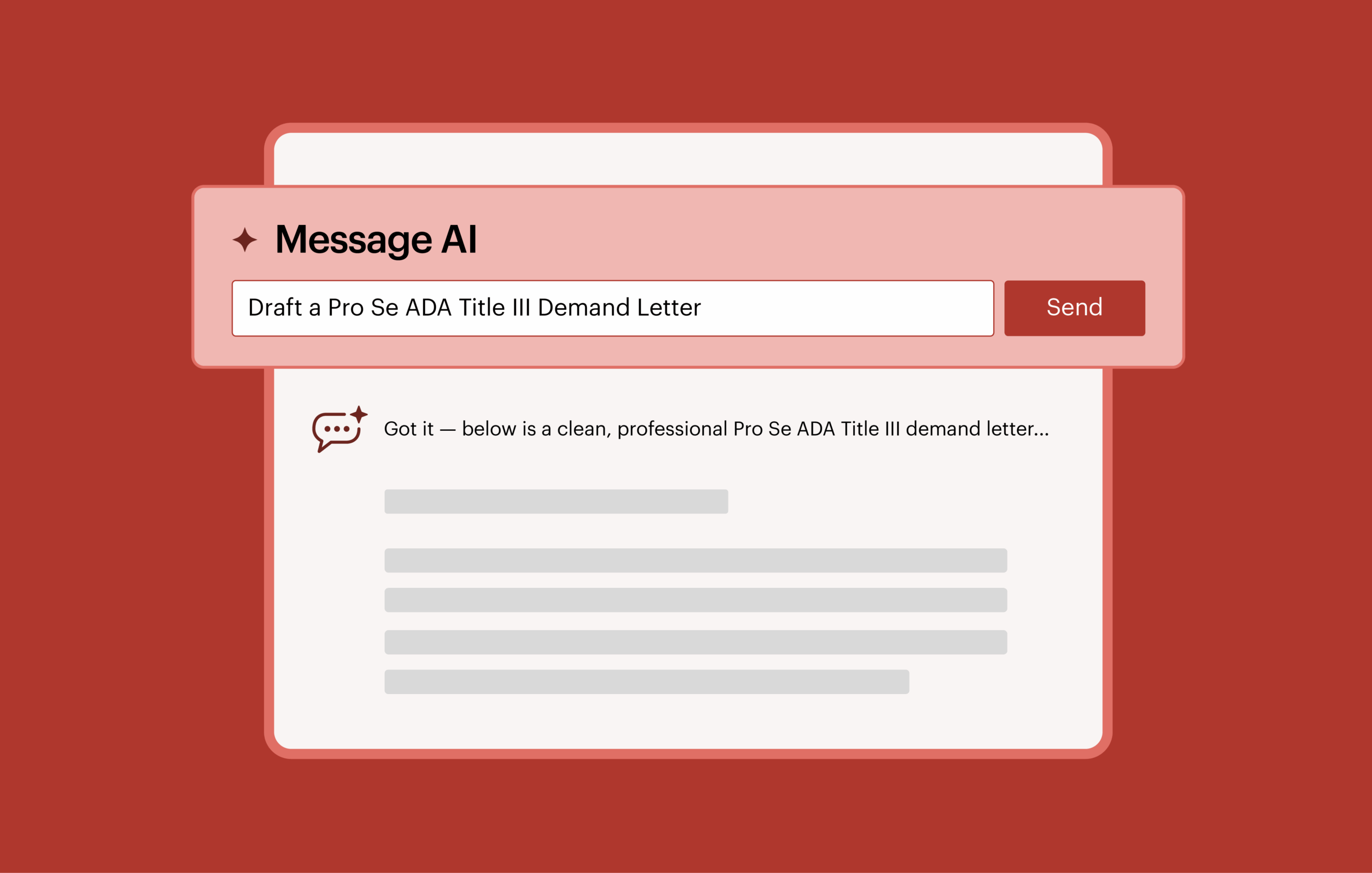
Now, with the rise of AI, there’s a new game in town, as people are using AI to file pro se lawsuits (lawsuits in which someone represents themselves).
AI-powered pro se accessibility lawsuits
There are many reasons someone might file a pro se lawsuit. Sometimes people believe they’re best equipped to present their own case. More often, however, it’s to save money on legal fees. Litigation is complicated, time-consuming, and out of reach for many people.
At least, it used to be.
ChatGPT and similar tools are changing that. According to Seyfarth, federal pro se ADA Title III lawsuits are up 40% in 2025 compared to 2024, with federal pro se FHA lawsuits up 69% during the same period. What accounts for the increase? As Seyfarth notes, “Most pro se litigants we encounter are using AI tools to help them litigate.”
AI is reshaping digital accessibility from every direction at once, creating new complications in the process. AI-powered coding tools help developers build faster, but much of that new content fails basic accessibility standards. AI is becoming essential for identifying and fixing accessibility barriers at scale, but not all AI tools are equally reliable or grounded in accessibility expertise. And now, AI is making it easier to file accessibility lawsuits, even though legal pressure alone doesn’t guarantee accessible experiences.
So what role should AI play in digital accessibility? What should businesses be doing to get ahead of legal risk? How do you reduce legal exposure while creating better products for the 1.3 billion people worldwide who have disabilities?
Why proactive accessibility is the right approach
The merits of any given lawsuit depend largely on intention. One lawsuit might get filed because a company continues to neglect its accessibility issues and it feels like the only way to instigate positive change, while another might be a predatory attempt to force a quick financial settlement. The reality on the receiving end is the same either way—a lawsuit to contend with.
The use of AI in pro se litigation introduces yet another challenge. A legal novice using AI is likely to be unfamiliar with litigation and courtroom proceedings. A situation like this could increase duration and cost as much as 50% as the individual attempts to navigate and negotiate in a complex federal court situation.
The key to navigating any of these situations is remembering that the ultimate goal is digital accessibility. Even the best-intentioned lawsuits are only a means to that end. The best approach is one where lawsuits aren’t necessary in the first place. Instead of reacting to demand letters and lawsuits, you can prevent them entirely by building accessibility into your products from the start and maintaining compliance over the long term. And the good news is that AI can drive this kind of proactive digital accessibility.
When we talk about proactive accessibility, we mean building accessibly from the start—combining AI-powered testing with human expertise to give developers speed that doesn’t create technical debt, to give businesses compliance that enables rather than hinders innovation, and to ensure people with disabilities have equal access to digital products, services, and experiences.
The key to this approach is staying focused on outcomes rather than mechanisms. This shifts the question from “are these lawsuits bad?” to “what actually creates accessible digital experiences?” Lawsuits—pro se or otherwise—are a symptom and response to a problem, not the problem itself.
How to achieve proactive digital accessibility
Proactive accessibility requires investment and culture change. It’s a practice shift that organizations must commit to. But when you contrast different approaches, the effort is clearly worth it.
From break-fix cycles to shift-left practices
Shifting left means moving accessibility testing to earlier in your development process. The immediate goal is to find and fix accessibility issues sooner, so you can save time, money, and effort on costly remediation downstream.
Too often, teams get stuck in a break-fix cycle, building and releasing new products while simultaneously fixing products that come back with accessibility issues. From an organizational standpoint, it’s inefficient and expensive. For developers, it’s frustrating and disheartening.
By shifting left, you increase efficiency, reduce issues, and free up your teams to focus on innovation and building more and better products.
From short-term settlements to long-term solutions
I’ve written previously about the real costs of accessibility litigation, examining whether it makes financial sense to opt for a quick settlement—especially when the lawsuit feels predatory (meaning it’s about extracting a financial settlement rather than encouraging the company to become accessible).
A well-known example cited in a recent Wall Street Journal article involved a seemingly small settlement of $4,950. But the legal fees? Nearly $40,000. That puts the real cost at approximately $45,000—more than twice what it would have cost to address the accessibility issues once and for all, an effort estimated at only $13,000.
While a short-term settlement might initially seem like the easy way out, it’s actually a recipe for trouble. Not only will you pay more than you think the first time, but you’re likely to be paying again soon when new accessibility issues arise. And they will arise, if you’re not taking proactive steps to prevent them.
From reactive tactics to proactive strategies
The most effective way to reduce costs and limit legal risk is to implement a comprehensive digital accessibility program where you’re not only finding and fixing issues sooner, but you’re preventing them from happening in the first place.
Shifting left is part of this, but there’s more to it than that. You need to integrate the right tools, implement role-based training, enable cross-functional collaboration and knowledge-sharing, and strike the right balance between automated and manual testing to ensure you’re making the most of your teams’ skill sets. Change management of this kind isn’t always easy, but the benefits far outweigh the challenges. Your costs go down, your reputation goes up, and your products get better and more inclusive—the most important goal of all.
Next steps
At this point, it’s already become a cliché: AI is not going away. To which I say, good, because there are very powerful and positive things that can be achieved with this technology. However, as I’ve hopefully made clear, there are real risks as well.
AI is all about speed and scale. In digital accessibility litigation, we’re seeing the same disruptive acceleration that’s happening everywhere else. What companies need to understand—as the Seyfarth numbers make clear—is that AI-powered lawsuits will increase in frequency and are likely to be predatory. Trying to defend against them is going to be costly, and opting to settle even more so.
The only viable way forward is to get and stay accessible now, before you’re exposed to litigation. As Harris’s quote makes clear, solving AI-driven challenges requires AI-driven solutions. Or, as I put it in another recent article, “the best defense is a good offense.”
Reach out to our strategic experts at Deque today. We can help you implement a proactive approach to digital accessibility that maximizes benefits while limiting risk.