
What is a Voluntary Product Accessibility Template (VPAT), and how does it help compliance?
What is a VPAT?
VPAT stands for “Voluntary Product Accessibility Template.” This template is used to draft your Accessibility Conformance Report (ACR). Your ACR clearly states which accessibility standards your product or service meets, and it warns users about any “accessibility blockers” they may encounter.
Technically, the Voluntary Product Accessibility Template (VPAT) is just that: a document template. Organizations use this template as a guide when drafting their products’ ACR (Accessibility Conformance Report). People tend to use the term “VPAT” to refer to both that generic template and their own specific VPAT-based ACR. For clarity, we’ll do likewise.
Think of a VPAT or ACR as a uniform way of communicating your product’s state of accessibility to vendors and people with disabilities.
How does a VPAT help with accessibility compliance?
While the exact VPAT form is not required, documenting the state of the accessibility of your digital assets is a requirement in many laws and regulations around the world. For the ADA, EAA, Section 508 and more, it is common for organizations to use a VPAT to demonstrate that they meet harmonized standards like WCAG and EN 301 549.
VPAT’s aren’t just about ticking a compliance box. Most importantly, they serve as a quick way for your users, vendors, and partners to see which product is best for them.
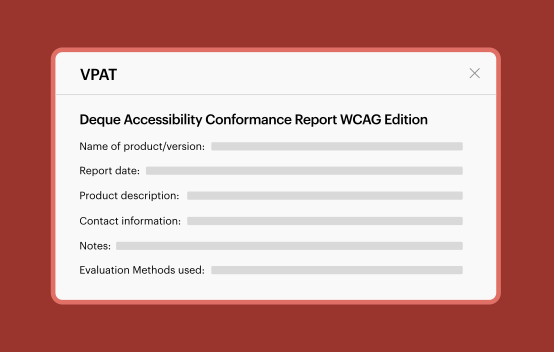
Producing a completed VPAT in three simple steps
Select your testing standard
Depending on where your users, partners and vendors reside, you might choose WCAG, EN 301 549 or other regional guidance.
Perform an audit
In a series of automated and manual testing efforts, measured against the Success Criteria that make up your testing standard, your product will earn a conformance level.
Publish the result
Your resulting Accessibility Conformance Report can be distributed via your website, partner or vendor portals and attached to RFPs to help demonstrate your state of accessibility and to earn business.
VPATs have a long-term accessibility program success
Codecraft Works partnered with Deque to perform a comprehensive web accessibility audit against WCAG guidelines and produced a Voluntary Product Accessibility Template (VPAT) on their online training portal—enabling learners everywhere with equal access.
Additional resources

VPAT, What’s That?
Learn how VPATs and ACRs can provide an efficient way to review the accessibility of products and services, mitigate litigation risk, and increase potential customers.

Essential Guide
Understand the basics of web accessibility with this handy collection of stats and definitions.

How to Build the Foundation For Digital Accessibility
Learn the organizational principles that need to be understood and accepted for you to succeed.
Frequently asked questions
What is the difference between a VPAT and an ACR?
Technically speaking, the Voluntary Product Accessibility Template (VPAT) is just that: a generic document template. When completed, this template transforms to become an ACR (Accessibility Conformance Report). It is common however, that folks use these terms synonymously.
Why do I need a VPAT or ACR?
Demonstrating how you meet compliance requirements is often a legal requirement, and a VPAT or ACR is a common and transparent way to achieve this. In addition to helping satisfy regulatory requirements, VPATs:
- Help buyers, especially in government or regulated industries, assess if a product meets their accessibility requirements.
- Support procurement decisions by showing compliance with legal or policy accessibility obligations.
- Help your organization demonstrate due diligence and commitment to accessibility.
- Facilitate communication between vendors and customers about accessibility improvements.
How often do I need to update my VPAT or ACR?
The frequency of updating your VPAT (Voluntary Product Accessibility Template) depends largely on several factors:
- Product Changes: Whenever there are significant updates or changes to your product—such as new features, UI changes, or functionality modifications—you should update the VPAT to reflect the current accessibility status.
- Standards Updates: If there are updates or changes to the accessibility standards or guidelines your VPAT references (like WCAG versions or legal requirements), it’s important to update the VPAT accordingly.
- Regular Reviews: Even without major changes, it’s good practice to review and update your VPAT at least annually to ensure it remains accurate and current.
- Customer or Contract Requirements: Sometimes clients or contracts specify how often the VPAT should be refreshed, so be sure to follow those guidelines if applicable.
