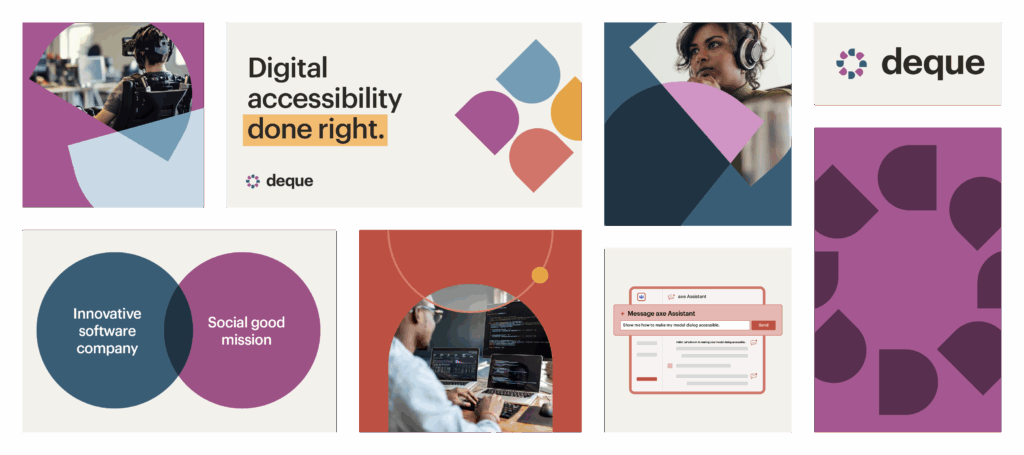
Here at Deque, there’s one thing that never changes—the mission. Digital equality has been our passion from the start, and it always will be.
But that doesn’t mean we’re afraid of change—especially when it moves our mission forward.
Positive change is how we make progress on our mission, and the world of accessibility has given us some great examples this year, most notably, the European Accessibility Act.
If you’re watching closely, you’ll start to notice some pretty neat changes right here at Deque in the coming months. To see them, all you’ll need to do is visit our website, where the core elements of our rebrand will begin going live.
Yes, it’s a rebrand! Though really, it’s about meeting transformation with transformation.
This has been an incredible year for digital accessibility, but it’s also been an incredible year for Deque. We’ve advanced boldly into a rapidly evolving landscape driven by technological and regulatory transformation, as our founder and CEO, Preety Kumar, wrote recently in an article titled The EAA and the new era of digital accessibility:
“Even as we see sweeping global impact at the regulatory level, we’re also witnessing groundbreaking advancements in technology that are changing the world faster than we could have imagined. This confluence makes for one of the most critical moments in the history of digital accessibility.”
Deque has always been about meeting the moment. In a time of incredible opportunity, we knew we needed to ensure we had the best platform possible for bringing our innovations and values to the global fight for digital equality.
So watch this space, because we’re going to be rolling out all kinds of new things as part of our rebrand. New pages for our products and partners, and new paths for finding exactly the resources you need—not to mention new colors, a new font, and a new logo!
We couldn’t have achieved this without the insights and support of so many people, both inside and around Deque. Community is at the core of everything we do, and that principle guided our entire rebrand process. We talked directly to our co-workers, clients, partners, and the passionate accessibility advocates who make up our global community. Together, your perspectives were essential to getting this right.
We do this because a rebrand is a little different when you’re an accessibility company. This is an opportunity to showcase beautiful and accessible design in harmony.
In addition to our commitment to accessibility, Deque is defined by being an innovative software company with a social good mission. Not just the one, not just the other. Capturing the essence of what that combination means was an essential part of this process, and it’s a foundation we go back to every day to ensure we’re showing up in the world as authentically as possible.
We can’t wait for you to experience what we’ve got coming, so like I said, watch this space. 2025 showed us all that positive change on a global scale is possible. As 2026 promises even more, we’re excited to be right there with you, driving our shared mission forward!
Ryan Bateman
Ryan is a Marketing leader at Deque. He's worked in the telecommunications and performance monitoring industries for over ten years and cares deeply about improving the web for everyone.
When it comes to the most exciting digital accessibility event of the year, there’s no better time to start planning than right now, because we’re revealing the full agenda today.
If you thought last year’s event was amazing, wait until you see what we’ve got in store for you in 2026!
We’ve already announced Dr. Rana el Kaliouby and Haben Girma as our opening keynotes; if you weren’t able to read about these incredible visionaries and allies in our previous announcement, you can learn more about their accomplishments and impact below.
But right now, let’s discover who else will be bringing their insights and knowledge to the Axe-con community at our 2026 event!
We’ve got experts from Adobe to Zendesk, and all points in between, including Amazon Web Services, Atlassian, Coinbase, GitHub, Harvard Business School, HSBC, IKEA, Kaiser Permanente, Microsoft, Northwestern Mutual, Peloton, Walmart, Wix, Workday, and more.
Day one highlights
Here are just some of the special sessions you can attend:
We’re elated to have Anna return to Axe-con, and this will mark her third conference appearance. Anna is a Senior Inclusive Designer at Microsoft, where she specializes in building inclusive products. In this talk, Anna will discuss non-deterministic design, a way of building systems that remain accessible even when no two interfaces are exactly alike. If you’re interested in questions such as “How do we ensure accessibility when outcomes aren’t fixed?” “How do we test what we can’t predict?,” this is the session for you!
Ire is an invited Google Expert in Web Technologies, and the co-founder of Helicarrier, a Y Combinator-backed blockchain company for Africa that built some of the continent’s earliest crypto-fintech products. In her presentation, she’ll discuss what digital inclusion means in 2026, and demonstrate how accessibility-first design can be the foundation for reaching your next billion users.
This incredible session brings together three experts from Thomson Reuters to discuss how to scale automated accessibility testing and achieve the best outcomes. Peter Bossley leads the Standards and Practice team within the Thomson Reuters accessibility program. He will be joined by Corey Hinshaw, Lead Accessibility Specialist, and Pavan Mudigonda, Lead QA Engineer, Developer Experience. All three will be debuting at Axe-con 2026!
Pawel is an Accessibility Lead Designer at Atlassian with over 20 years of design experience. Pawel will share insights into how Atlassian has embedded Accessible Design Specialists and supported them with clear growth profiles, simple processes, and focused tools. He will also share strategies for recruiting and growing specialists, defining day-to-day expectations, and partnering with them in their day-to-day work.
Day two highlights
Here are some of the fantastic options for day two of Axe-con:
Jennifer is a founding member of the Product Accessibility team at Zendesk, and was recognized as one of 14 Power Women in Code by the DCFemTech Awards. In this cleverly structured presentation inspired by the TV shows “Is It Cake?” and “Candy or Not Candy?,” this interactive session will help you learn how to tell accessibility impostors (interfaces that look accessible but aren’t) apart from the real deal.
Ryan is Director of CX/UX Advisory Services at Wolters Kluwer, a global leader in information, software solutions, and services. In his presentation, Ryan will share insights into his organization’s focus on strengthening interaction expectations and reusable UI foundations through accessibility reviews, design system improvements, and the centralization of practical authoring guidance.
Mali Fernando, Group Head of Digital Experience and Accessibility, HSBC
Mali is a multi-award-winning digital leader in banking. He was recognised in the King’s New Year’s Honours list of 2023, where he received an MBE for his contribution to banking and technology.
Matt King, Accessibility Specialist in UI Engineering, Meta
Matt King is a groundbreaking engineer and a champion for software accessibility. As the first blind engineer at Facebook (now Meta), he works to ensure that technology is designed for everyone, including people with disabilities.
Keynotes
In case you didn’t see our previous Axe-con announcement about our keynote presenters, here are the details!
Rana is a true pioneer in artificial intelligence. She co-founded Affectiva, credited with creating and defining the new technology category of Emotion AI. Rana has since founded Blue Tulip Ventures, an early-stage venture firm that invests in startups building human-centric AI. She is also an executive fellow at the Harvard Business School and co-chair of the Fortune Brainstorm AI conferences. If that’s not enough, Rana is also the author of a best-selling memoir, “Girl Decoded: A Scientist’s Quest to Reclaim Our Humanity by Bringing Emotional Intelligence to Technology,” and has been recognized on Fortune’s 40 Under 40 list, Forbes’ Top 50 Women in Tech, and Boston Globe’s Top 50 Tech Power Players.
This will be Rana’s inaugural appearance at Axe-con, and we are elated to have her open our conference in 2026. If you’re interested in the intersections of humanity and technology and are eager to glean deeper insight into the future of AI, you’ll want this right at the top of your itinerary.
Speaking of itineraries, make sure to register for free today so you can start building out your agenda with your favorite sessions. February 24 will be here before you know it.
While Dr. Rana El Kaliouby will be debuting at Axe-con 2026, our day two opening keynote will be delivered by someone we’re all very excited to welcome back to the conference: Haben Girma!
We have been very fortunate to have so many incredible Axe-con presenters join us over the years, and the days and weeks following each conference are always a joy as we gather event feedback and hear from the community about which presenters you most loved and appreciated. It’s no exaggeration to say that Haben is one of our most requested returnees, and we’re thrilled to have her back.
Among her many achievements, Haben is also a celebrated memoirist. The New York Times, Oprah Magazine, and TODAY Show have all featured her book, Haben: The Deafblind Woman Who Conquered Harvard Law.
In addition to being the first Deafblind person to graduate from Harvard Law School, President Obama named her a White House Champion of Change. She has also received the Helen Keller Achievement Award and been included on the Forbes 30 Under 30 list. President Bill Clinton, Prime Minister Justin Trudeau, and Chancellor Angela Merkel have all honored her work as a human rights lawyer advancing disability justice.
Register for free today
Mark your calendars for February 24-25, 2026, check out the agenda, and complete your registration today!
All told, Axe-con 2026 will feature more than 45 sessions across development, design, organizational success in accessibility, and the wildcard track.
Truly, Axe-con has something for everyone. Please consider this your invitation to join your fellow developers, designers, business users, and accessibility professionals of all experience levels as we rally to advance digital accessibility programs everywhere.
And remember, your registration ensures that you’ll have access to the conference recordings, so even if you’re not able to attend all your favorite sessions live, you can still experience every inspiring and insightful moment.
“I’ve been working to advance digital accessibility for over twenty years. In that time, I’ve seen both successes and setbacks. But like everyone committed to this mission, I have never wavered in my faith that digital accessibility is the future. Well, that future is here.” —Preety Kumar, CEO and founder, Deque
Please join the global Axe-con community at Axe-con 2026 as we come together to create the future of digital accessibility in real time!
Deque Systems
Deque is the global leader in digital accessibility, helping the world’s top enterprises build inclusive products, services, and experiences and achieve lasting compliance. Recognized by leading industry analysts for its AI-powered tools, comprehensive services, and developer-trusted solutions, Deque delivers the industry’s most complete accessibility offering. The Axe platform, anchored by Axe-core, has more than 3 billion downloads and 875,000 installed extensions, making it the global standard for accessibility testing. As a pioneer of people-first accessibility, Deque applies a human-in-the-loop approach that blends expert insight with AI innovation to advance its mission of digital equality for all.
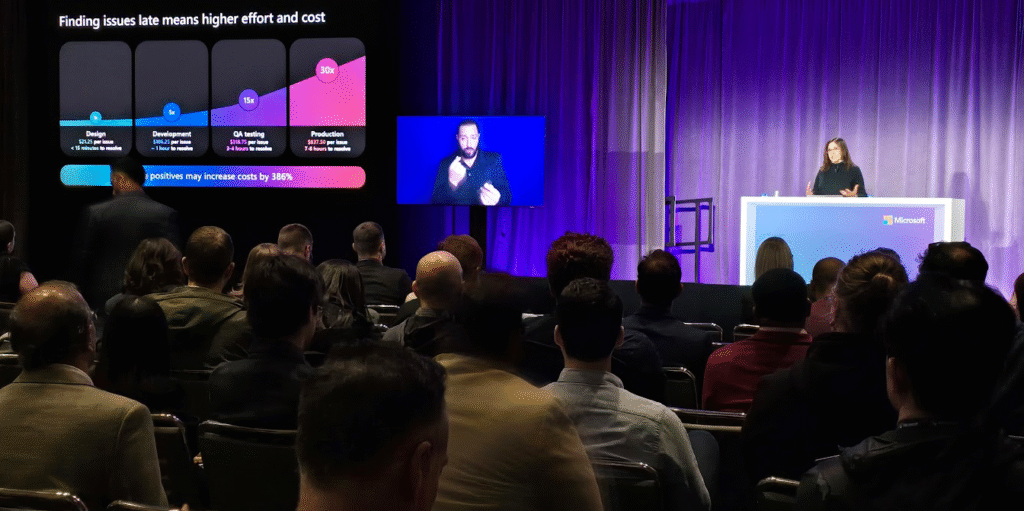
Deque founder and CEO Preety Kumar took the stage at Microsoft Ignite on November 18, joining Jenny Lay-Flurrie, Microsoft’s Chief Accessibility Officer, and Ed Summers, Head of Accessibility at GitHub, for a presentation titled “Building for Everyone: How Accessibility is Shaping the Future of AI.”
Jenny got things started with a delightful welcome, immediately charming the full room with a query about whether there had been long lines at lunch. She then embarked on a brief but comprehensive overview of what digital accessibility is and why it matters.
She covered Microsoft’s commitment to what she termed “accessibility at the speed of trust,” and outlined the three components of their approach: skilling, inclusive design, and listening systems.
If you’ve enjoyed a presentation from Jenny before, you know she’s got a tremendous knack for approachably balancing the tangible and the technical, and her self-styled “British sarcasm” certainly plays a key role in that—she got quite a laugh from the crowd when she asked if anyone had heard of AI!
Before closing her segment, she made a direct and powerful plea to the audience: “If you’re not yet invested in accessibility today, I ask you to change that … we need all of you. Lives change because of this work.”
All of us at Deque know this to our core, and it’s why we were thrilled to be a part of the Ignite experience. We were especially gratified by Jenny’s introduction of Preety, where she highlighted Deque as “one of our most amazing partners that we have worked with for decades.”
Part of the magic of Ignite is the scale of the event itself; it’s massive, and the actual experience serves to reinforce the scale of ambition that is everywhere present. Preety herself wasted no time clarifying Deque’s ambitions, stating right from the start that “our mission is to help every organization become and stay accessible.”
After giving the audience an introduction to our approach—which brings together technology, education, and services—she spoke directly to the question that seemingly looms over every discussion about AI: Will it help, or will it hurt?
When it comes to digital accessibility, Preety’s answer was clear: AI will help. It gives us the power to fix thousands of issues at a time at a pace never before possible, and, even more importantly, to proactively prevent issues in the first place.
In mentioning proactive digital accessibility, Preety echoed Jenny’s earlier assertion that “we must shift left,” and noted that when issues aren’t addressed until production, costs soar.
Preety continued to build on the themes that Jenny established, offering a twist on her “at the speed of” language to introduce the concept of “accessibility at the speed of AI.”
Agentic AI is central to this new era of digital accessibility, and Preety outlined Deque’s vision for an approach that combines the speed and scale of AI with human expertise to create a system where developers are in the driver’s seat, supervising code and making expert determinations about what to approve, improve, and reject. What this approach does is to create a continuous loop—code, find, fix, validate—that happens “at the speed of AI.”
Preety has been known to rely on her fair share of driving metaphors in her presentations. At Ignite, she memorably extended her “driver’s seat” analogy to include false positives, likening them to an air bag exploding when the car hasn’t actually been in a collision!
While this was the first mention of false positives, it was not the last. During the closing portion of Ed Summers’ presentation, he referred to no false positives as a “gift” from Deque and described Axe-core as “the gold standard of website scanning.”
Ed also touched on the theme of a “continuous” AI-powered cycle, joining Jenny and Preety in highlighting the need to “shift left”:
All three presenters delivered a wealth of insight and information, with Ed’s final comments taking everyone right to the final seconds of the allotted time. While there wasn’t time for live Q&A, the recording from the presentation will be available on the Ignite website, and we look forward to continuing the conversation with our global community.
We want to thank Microsoft and the Ignite team for an incredible conference experience, and especially Jenny Lay-Flurrie and Ed Summers for being such brilliant co-presenters. We are also grateful to everyone who attended live or watched the event online.
As all conferences must, Ignite comes to an end, but the mission of digital accessibility is ongoing. And, as Jenny said, we need you all!
Deque Systems
Deque is the global leader in digital accessibility, helping the world’s top enterprises build inclusive products, services, and experiences and achieve lasting compliance. Recognized by leading industry analysts for its AI-powered tools, comprehensive services, and developer-trusted solutions, Deque delivers the industry’s most complete accessibility offering. The Axe platform, anchored by Axe-core, has more than 3 billion downloads and 875,000 installed extensions, making it the global standard for accessibility testing. As a pioneer of people-first accessibility, Deque applies a human-in-the-loop approach that blends expert insight with AI innovation to advance its mission of digital equality for all.
As a developer, you’re probably already contending with digital accessibility in some capacity. Pretty much everyone is, because that’s the world we live in now. And that’s a good thing, because it’s the right thing.
When shipping features and writing components, accessibility is increasingly a given. Developer teams are leading by example, building accessible products from the start, setting new standards for the industry, and using world-class tools to make a lasting impact.
By enabling this work, companies are demonstrating their commitment and raising awareness that accessible code is no longer optional—it’s essential.
However, while incorporating accessibility as we code is essential for preventing barriers from creeping into the digital experiences we create, being essential doesn’t mean the process is friction-free.
Awareness is progress, but awareness alone doesn’t erase the challenges of tight deadlines, changing priorities, legacy code, and uneven understandings across teams. A new kind of advocacy is needed.
Advocating for accessibility means pushing to do what’s right—for our users and the health of the codebase. That tension between doing what’s right and shipping fast is something most developers face daily. To succeed, accessibility advocacy must address this tension head-on, and who better than developers to lead the way?
Balancing velocity and accessibility
As developers, we’re expected to move quickly to deliver net-new features and keep value flowing. That’s part of what we thrive on.
But when new features go out and accessibility issues start coming back in, we run into trouble. Bugs, audit findings, and requests for fixes can pile up. Sprints meant for innovation have to pivot to remediation. Before you know it, instead of building something new and exciting, you’re revisiting something old—repeatedly.
That constant loop can wear you down. Velocity drops, tension builds, and digital accessibility can start to feel like a blocker instead of a core part of quality engineering.
For many developers, the challenge isn’t the willingness to code accessibly, it’s getting the support and buy-in from your team leads. You want to do the right thing, but without clear guidance or the right tools, progress stalls, and you’re stuck in the break-fix cycle.
The break-fix cycle
As time goes on, the lack of support and alignment starts to slow everything down. You ship a feature, and it gets flagged for accessibility issues. It comes back for fixes, and you fix it and send it out again. Then the same thing happens in the next sprint, and the next, and the next after that, and on and on it goes. This is the dreaded break-fix loop: something ships, breaks, gets patched, and ships again.
It’s not efficient, and it’s not satisfying. Your backlog fills with remediation tickets, and your velocity inevitably drops. Now, management wants to know why features aren’t moving faster, and they’re pointing the finger at you, even though it’s not your fault, and it’s not from lack of effort. You want to move faster, but how can you, when you lack the clarity, resources, and processes to build things accessibly from the start?
Shifting left as the solution
There’s a way out of this cycle.
You’re likely familiar with the term “shift left.” It refers to catching issues earlier in the development process—before they reach production. We’ve seen a shift to left work in the realm of security. Most developers would shy away from leaving an API key exposed in their source code before pushing it to GitHub. It’s about incorporating secure practices at every step.
The same principles apply to digital accessibility.
Conducting accessibility testing as you code means it’s part of your everyday workflow, rather than an afterthought. That’s what shifting left is really all about. However, that shift doesn’t happen automatically. It starts with education and awareness.
Developers want to do the right thing, but how can we do so if we haven’t been shown how? We don’t know what we don’t know. Once teams understand the fundamentals of accessibility—what matters, why it matters, and how to apply it in code—tools become far more effective. Education provides the knowledge; tools make it faster and easier to act on that knowledge.
Education resources like Deque University are literally the standard for learning digital accessibility. You can even take it a step further with Axe Assistant, Deque’s very own accessibility chatbot. It’s trained on Deque University’s knowledge base, the world’s largest, most comprehensive, and most trusted accessibility resource. You can ask Axe Assistant relevant accessibility questions, and it can return principles and code snippets you can add to your repository.
Tools like the Axe DevTools Extension can automatically catch most accessibility issues upfront before code even reaches QA or production. Once you see that in action, the benefits become clear. Less rework, fewer blockers, and more time spent building new features instead of fixing old ones that came back for remediation.
Shifting left restores your velocity by equipping you to fix the issues in your environment before handing them off to someone else. You have the power to build with digital accessibility in mind from the start. You’ll reduce your backlog and be able to get back to doing what you love—shipping great code that’s usable for everyone.
Igniting organizational change and advocating for digital accessibility
Individual effort makes a huge difference, but lasting change happens when digital accessibility becomes part of how your entire organization builds. Crucial conversations have to happen at the team, managerial, and executive levels. These conversations can start small, with a single developer asking the right questions. From there, changes ripple outward to dev leads, product owners, scrum masters, and risk teams. Eventually, it becomes clear that shifting left and embracing proactive accessibility is about digital transformation at the highest levels.
However, the change doesn’t initially have to be this huge thing. It can start with small, visible wins that prove the value early and give leadership something tangible for them to stay invested.
Drive that momentum. Talk openly about how much time is lost to rework, how many sprints get clogged with fixes, and how much faster things move when accessibility is built in from the start. Framing digital accessibility as a way to protect velocity and maintain speed builds the business case for accessibility. It enables everyone to see it not as extra work, but as smarter work.
If your developers are ready to take the next step, we recommend pairing education with practical tools. Encourage your organization to:
Provide developers with access to Deque University for hands-on learning.
Enable Axe DevTools in local or CI environments so accessibility checks run early.
Use Axe Assistant to give developers quick, reliable answers without waiting on specialists.
These small changes can spark a broader shift. Once teams see how education and the right tools accelerate delivery, accessibility no longer feels like a blocker and becomes the new standard for quality engineering practices.
Your role as the hero
Be the advocate who takes the lead on accessibility. You won’t just improve your own code quality or how your team works—you’ll help transform your entire organization. You can be the one showing that building accessibly saves time, reduces rework, and helps everyone ship faster. You’ll be setting an example, proving that accessibility is an engineering best practice requiring lower effort than may be assumed.
This is where real change starts: one developer setting the example, asking the right questions, and showing that quality and velocity can coexist. You’ll be helping your team move from reactive fixes to proactive progress.
If you want to keep learning and connect with others who care about building accessible experiences, join the Axe Community on Discord. It’s a friendly space where developers share tips, ask questions, and talk through real accessibility challenges. Come hang out, learn from each other, and be part of the growing accessibility movement.
And remember, you’re the hero who helps your organization build better, for all users.
Let’s get started.
Jeremy Rivera
Jeremy Rivera is a Developer Advocate for Deque Systems Inc. He is a full-stack MERN Developer and a University of South Florida alum. Jeremy transitioned to developer relations to bridge the gap between software and developers needing a diverse array of tools. He is a general technologist and evangelist of open-source and cloud-based tools, passionate about helping developers make the web a more inclusive environment.
Deque’s global community recently came together for the debut of a brand new type of event: an Axe-con Mini!
You may be familiar with our annual Axe-con event. It’s the world’s largest digital accessibility conference—a two-day, multi-track experience featuring dozens of keynotes and presentations covering a vast range of accessibility topics.
By comparison, an Axe-con Mini offers all the excitement, insight, and expertise of Axe-con, but contained in a single, compact event. For our inaugural event, it was “dev-day,” and our theme was “Removing friction from accessible development.”
We were very excited to have the following expert guests join us for this special session:
As wonderful as it was to bring all these experts together, it’s always the global community that makes every Axe-con event special—and we do mean global!
Among the countries represented at our debut Axe-con Mini were Austria, Canada, France, Germany, India, Israel, Kosovo, Portugal, Spain, Sweden, and Turkey. As for here in the United States, we had guests join in from California to Florida and everywhere in between, including Michigan, Montana, Texas, and more.
Things got off to a fantastic start with Vitaly Friedman’s presentation titled “Frustrating Accessibility Nightmares In 2025 and How To Fix Them.” If you’ve enjoyed a Vitaly presentation previously, you know he’s a master of making the very tactical very entertaining, and this talk was no exception. He dove right into CAPTCHAs, search filters, FAQs, navigation, and infinite scroll, asking about the latter (with a comically theatrical sigh), “What IS the deal with infinite scroll?”
He then proceeded to respond to his own question, with an answer that culminated in ten actions you can take to improve infinite scroll experiences:
If in doubt, always prefer pagination.
With infinite scroll, always integrate a footer reveal.
Consider separating “old” and “new” items visually.
Allow users to pin a position and continue later.
Experiment with “load more” + infinite scroll.
Experiment with pagination + infinite scroll.
Change the URL as new items are loaded in.
Allow jumps to any page with a pagination drop-down.
Consider using scrollbar range intervals.
Always consider accessibility and performance issues.
If running down a litany of accessibility “nightmares” sounds a bit dreary, Vitaly’s presentation was anything but, and he ended on a note that was characteristically both practical and inspirational:
“What people like is when things are fast and accessible. When you have large and legible text. When you have checkboxes that look like checkboxes. When you have input boxes that look like input boxes. It’s all been the same for the last twenty years, but there’s absolutely no magic behind it, right? And we’re already doing so much right. It’s unbelievable. It’s just that, sometimes, we are struggling with retaining accessibility rather than building it in. So, I’m sure that with your incredible effort, we can do better.”
“With your incredible effort, we can do better.” —Vitaly Friedman, Founder, editor-in-chief, creative lead, Smashing Magazine
While there were countless positive comments in the chat after Vitaly finished, this one nicely sums up how people felt:
“Vitaly is the GOAT.”
Enterprise AI workflows that ship clean, compliant, accessible code
Next up came Jenny Lay-Flurrie. Jenny is, of course, no stranger to the Axe-con community. She has presented at Axe-con in the past. In 2023, Deque recognized her work at Microsoft, presenting Microsoft with the “Accessibility at Scale” award. Deque also recognized Jenny personally, presenting her with the Jim Thatcher Lifetime Achievement Award.
The scope and scale of Microsoft’s impact means that Jenny’s perspective and insights on the accessibility profession are always invaluable:
“As accessibility leaders, our job is two-fold. One is to make sure that you are building a systems-based culture of accessibility within your company and ecosystem. The second is to make sure that you are also helping your customers by being accessible with the products that you produce. And how do we really make sure that we deliver on that? It is about trust.”
“It is about trust.” —Jenny Lay-Flurrie, Vice President, Chief Accessibility Officer, Microsoft
Coming as she does from a place of deep experience and influence, her words during this event served a powerful call to action:
“We have to live and breathe the principles of inclusive design. If we just stick with that floor of conformance and compliance, we’re not going to deliver on the potential and the community needs that there are for assistive technology.”
Jenny’s observations about the new era of AI and accessibility were particularly profound:
“Clearly, we’re in the era of AI, and we’re also in the era of what I’m framing as a tidal wave. If we don’t put our arms around AI in the right way, we will be propagating some of the harms that have been inherent in our community over the last few decades.”
As to how to respond to this new world?
“We need to shift left. Shifting left is how we avoid the tidal wave.”
Deque CEO and founder Preety Kumar presented next, quickly weaving together threads from both Vitaly and Jenny’s presentations, acknowledging the efforts we’ve made while highlighting the urgency of accelerating our efforts to meet the challenges presented by an AI-powered world:
“Last year, 96 percent of the web was inaccessible. This year, it’s 95 percent. We’ve made 1 percent progress. And what keeps me up at night is that with AI, we’re getting more and more prolific. We’re going to create more and more code. All of us are becoming more productive, but with AI, I think all of us collectively understand that we must take personal responsibility for the code that we produce. Otherwise, the problem is going to get bigger, we’re going to get to 98 percent inaccessible instead of that 1 percent that we gained, and I don’t want that to happen.”
“We must take personal responsibility for the code that we produce.” —Preety Kumar, CEO, founder, Deque
Dylan Barrell, Deque’s CTO, dug further into this line of thinking:
“I don’t think there’s any serious company out there that would deploy code to production—whether it’s written by a human or written by AI—that hasn’t been tested for functionality, as well as things like accessibility, security, and performance. I think that having a healthy amount of distrust for the code that you’re generating is a healthy thing.”
Dylan made clear, however, that “healthy distrust” needs to scale at the same pace as AI:
“The gap between the amount of code that we’re generating and the amount of automated testing of that code that we can do is increasing. In this age of development at the speed of AI, anything that’s done manually is going to be perceived as a drag on productivity. It’s increasingly unlikely that we can fill this gap by adding more and more manual resources to the problem. So, we have a concern here.”
Fortunately, as Dylan stated, there is a way forward:
“At Deque, we believe very strongly that what we need to do is fight the AI fire with AI itself. We need to look for ways that we can leverage AI to get ahead of this problem.”
“We need to fight the AI fire with AI itself.” —Dylan Barrell, CTO, Deque
At Preety’s urging (“Come on, Dylan, developers want to see real stuff working, do it live!”), Dylan proceeded to demonstrate “accessibility at the speed of AI” in four steps:
Step 1 Give your AI agent (e.g., Copilot or Cursor) a digital accessibility task (e.g., make this code accessible).
Step 2 It will call the axe Platform through MCP to understand the accessibility task and prompt (using axe Assistant) on how to best resolve the issue.
Step 3 The AI agent will use that information to suggest a code change in your IDE.
Step 4 The developer can decide to accept, edit, or reject the suggested change in just one click.
Jump to 1:08:41 to watch this portion in the video demo.
AI agents and accessibility
Anytime we’re talking about AI and accessibility, we have to think about the role that human expertise plays in the process, and our presenters from Salesforce were excellent on the subject of how AI agents—specifically, Agentforce Vibes from Salesforce—can be “accessibility buddies.” Here’s Karen Herr, explaining more about this concept:
“As accessibility practitioners, we don’t want to cause harm. I don’t want the tool to go in and make a component worse for someone with a disability. And we don’t want to replace humans and human judgment. We know that humans have to be the ones who decide to accept or reject changes. We have an ethical responsibility to make sure that we are using our powers of discernment now more than ever. The LLMs are a ‘sidekick’ to work beside us—not to replace us and our level of discernment.”
“We have an ethical responsibility to make sure that we are using our powers of discernment now more than ever.” —Karen Herr, Director, Product Accessibility, Salesforce
Accessibility in the role of automation
After a short break, we returned for the closing portion of the event, a presentation from Deque’s own Wilco Fiers on “Accessibility in the role of automation.” Wilco’s premise was straightforward: “AI-written code is often inaccessible. These things are trained on the web, and the web is largely inaccessible. So, there are problems there.”
To address these problems, Wilco focused on two key topics: 1) Advances in automated rules, and 2) Automated Intelligent Guided Tests (IGTs).
Regarding automated rules, Wilco described a new rule set developed to run alongside Axe-core. These fully automated rules address some of the most common accessibility issues that currently require manual review:
Headings lacking semantics
Presence of focus indicator
Multi-color text contrast
Incorrect decorative images
Incorrect informative images
Wilco noted that, with these rules, automated coverage has increased from about 57% to around 65%, with further measurement underway.
Wilco then moved on to Intelligent Guided Tests (IGTs):
“An IGT takes you through a question-and-answer process; it asks you questions about different things on the page. Based on the answers you give, it will figure out what the accessibility problems are. If you’re not an accessibility expert, you’re still able to test that page for accessibility issues.”
Specifically, he detailed how Deque is working to automate this process:
“Instead of having those questions posed to you, what will happen now is you start this IGT, it analyzes the page using AI, it attempts to come up with the answers for these questions, it fills those out, and then presents the results to you, so you can review them.”
Central to this process is human involvement:
“We’re trying to make it easy to override and leave the final judgment to you, because, ultimately, you, as humans, you, as developers or as testers, are the people who know these components best and can best make these judgments.”
“You are the people who know these components best and can best make these judgments.” —Wilco Fiers, Senior Accessibility Engineer, Deque
Wilco highlighted four “minimal requirements” for getting AI in accessibility right:
Explicit uncertainty reporting (confidence or other)
Transparency of AI decisions
Direct human verification
Easy to correct when wrong
And four risks of getting it wrong:
Wrong violations waste developer time
Missed violations ship to production
Confusion about accessibility requirements
Erosion of trust in accessibility testing
What’s next for Axe-con Minis?
As our first Axe-con Mini event made very clear, even a three-hour session can spark the same illuminating exchange of ideas that has always defined the Axe-con experience.
The good news about Axe-con Minis is that you won’t have to wait an entire year before the next one! Make sure to bookmark our Axe-con Mini page, as we’ll post updates about the next event soon. If you’re interested in hosting your own Axe-con Mini event, contact us today!
Thank you to our wonderful presenters, and thank you to everyone who joined us from around the world. You are why we do what we do, and you are why the mission is possible. Let’s keep building an accessible world for all!
Deque Systems
Deque is the global leader in digital accessibility, helping the world’s top enterprises build inclusive products, services, and experiences and achieve lasting compliance. Recognized by leading industry analysts for its AI-powered tools, comprehensive services, and developer-trusted solutions, Deque delivers the industry’s most complete accessibility offering. The Axe platform, anchored by Axe-core, has more than 3 billion downloads and 875,000 installed extensions, making it the global standard for accessibility testing. As a pioneer of people-first accessibility, Deque applies a human-in-the-loop approach that blends expert insight with AI innovation to advance its mission of digital equality for all.
For decades, accessibility in India was viewed as a thoughtful addition, not as something essential. That’s now changing.
The Government of India has introduced draft accessibility standards (PDF) that will reshape how people design, build, and experience the world.
These wide-ranging draft standards cover everything from commonplace physical items such as kitchen tools, shoes, and elevators to the websites, kiosks, and mobile apps we engage with every day.
When implemented, these standards will make accessibility a required part of daily consumer life—the norm, not the exception.
This is more than regulation. It’s a mindset shift, and India has the opportunity to demonstrate its commitment to innovation and inclusivity on the world stage. For business leaders, this is the moment to prepare, to adapt, and to lead. Those who act early will be the visionaries. The rest will just be trying to keep up with requirements.
What’s new
India’s draft accessibility standards represent a major step forward in how accessibility is defined and managed. The new approach focuses on three main ideas: making everyday items physically accessible, prioritizing digital accessibility, and adopting a holistic approach that treats physical and digital experiences as interconnected.
Extending physical accessibility to everyday life
For the first time, accessibility rules will apply to more than 20 types of everyday products used by millions, such as kitchenware, clothing, furniture, medical supplies, childcare products, packaging, and more. The aim is to make these items easy, safe, and inclusive for everyone, regardless of ability. Accessible examples include utensils that are easy to grip, packaging with tactile and Braille labels, adjustable furniture, and shoes with accessible fasteners.
Prioritizing digital accessibility
The new standards acknowledge that digital products and services, such as payment terminals, kiosks, mobile apps, and websites, are now as commonplace as physical products. The draft standards require all digital interfaces to work with assistive technologies like screen readers and voice commands, use high-contrast visuals and tactile feedback, and offer audio instructions.
A holistic, unified accessibility framework
Implicit in India’s new draft standards for accessibility is a key premise: everyday life doesn’t distinguish between physical and digital experiences, so accessibility shouldn’t either. For example, the new standards introduce a rating system that will be applied to both physical and digital products. Based on the POUR principles (Perceivable, Operable, Understandable, and Robust), products will be tested and rated from Level A to AAA based on how accessible they are. Regular audits and penalties will help ensure that companies follow the rules. The standards require that people with disabilities be involved at every stage, from design to testing, to ensure products are truly usable.
Why this matters for businesses
Together, these changes extend and expand how accessibility is understood and achieved in India, and establish a new set of rules for how accessibility is required throughout everyday life.
These changes will have a direct impact on organizations that produce physical and digital products, services, and experiences.
Your offerings will be tested and rated, and failure to comply will introduce potentially serious financial, legal, and reputational risk for your organization.
To successfully meet these standards and mitigate these risks, you’ll need to be proactive and focus on early planning, design, development, and ongoing testing.
What can your business do today?
While we don’t know the exact timeline for when these new standards will be implemented, momentum for digital accessibility in India is rapidly increasing. It seems prudent to assume more changes are coming.
We’ve already seen significant moves from the Securities and Exchange Board of India (SEBI) on accessibility, as well as from the Supreme Court, who, in April 2025, delivered a landmark ruling that affirmed that digital access is a fundamental right under Article 21 of the Indian Constitution (Right to Life), and the Bureau of Indian Standards (BIS), who introduced IS 17802 in 2023, which strengthens existing provisions regarding ICT products and services.
In light of this momentum, your organization has a choice: start planning now and be ready when the changes come, or wait and then try to react fast enough to avoid any negative consequences.
Given that non-compliance involves serious risk—including fines, recalls, and public disclosure—the choice should be clear. Consider your team’s current velocity as well. How long will it take your organization to get educated on digital accessibility, equip teams with the right tools and processes, and start delivering results? You don’t want to still be figuring these issues out when the new standards are already being implemented.
Proactivity is going to be especially important because the new standards will involve rigorous testing by accredited bodies and a rating system that will clearly label products from Level A to Level AAA.
Let’s look at some basic steps your organization can start taking today to ensure you’re prepared when the new standards are implemented.
Integrate accessibility checks into existing processes
Automate accessibility scans through tools in your development pipeline to catch problems with code before release. Combine these with manual testing using assistive technology such as screen readers and keyboard navigation to cover gaps that automation misses. These steps help you find and fix accessibility problems continuously—not just at the finish line.
Embrace a shift-left approach
Shift accessibility testing and remediation to the earliest design and development phases—in other words, shift left. By catching issues early and fixing them before they hit production (or worse, your customers!), you save time on costly remediation. You’ll also have fewer issues overall, which means less risk.
Conduct audits and prioritize fixes
Use audits or gap analysis to determine where you have accessibility issues, and then prioritize them based on impact and effort. For example, prioritizing easier fixes can help you quickly make significant progress, generating momentum. Prioritizing fixes on high-traffic pages, on the other hand, may be more complex, but the improvements will have a larger impact.
Provide role-specific training
Provide role-based training for all roles, including designers, developers, and QA testers, as well as your marketing, customer support, and product teams. Individuals and teams can sign up for modern accessibility courses (like those at Deque University), attend webinars, or work with invited expert trainers. Accessibility is a company-wide concern, and having cross-functional alignment and knowledge increases efficiency and efficacy.
The above are some foundational best practices for accessibility.
Something else you’ll want to get ahead of is having people with disabilities involved in your processes. The new standards require collaboration with people with disabilities throughout the entire product lifecycle.
Finally, it’s important to assess accessibility through the lens of risk, and understand that risk comes in many forms, including:
Legal: Failure to make products and services accessible can expose your organization to lawsuits, as well as the fines, recalls, and exposure mentioned above.
Financial: Financial risk goes beyond fines. If your organization embeds accessibility throughout your processes, and does not shift left, your likelihood of releasing inaccessible products goes up, which means your remediation costs go up. Market share is another factor. If your organization is exposed for not being accessible, that opens the door to accessible competitors to step into the breach and claim greater share, hitting your bottom line.
Reputational: Reputational risk goes beyond public disclosure and potential loss of market share. Increasingly, people shop with their values, choosing organizations whose business values they believe align with their personal values. Businesses that prioritize inclusivity see increased brand loyalty. Businesses with poor reputations suffer.
Be a part of the bigger story
India is moving to expand accessibility into our everyday physical and digital lives. These new draft standards aim to make sure everyone, regardless of ability, can easily and safely use the products and services that are essential in our modern world.
These standards are not suggestions—they’re mandatory, enforceable requirements spanning 20 major product categories. They include features like Braille, tactile labels, audio instructions, and digital screen compatibility with assistive technologies.
For businesses in India, this is a bigger story than just a new layer of compliance boxes to tick off. This is a revolution in thinking about how our physical and digital lives interact, and what accessibility and inclusivity really means. The new standards make accessibility a mandatory component of our everyday lives. This is a radical process.
As a business leader, this is your chance to take your place at the vanguard. Yes, it’s about adopting processes and tools to streamline accessibility and save time and money at the product lifecycle level. Yes, it’s about proactively engaging and collaborating with people with disabilities. Yes, it’s about rigorous testing and continuous improvement.
But more than all that, it’s about being a leader in the new era of accessibility. India is taking its place on the global stage as a leader. Your business needs to be a part of that story.
Next steps with Deque
Deque has a proven track record of supporting organizations with interpreting new standards, strategizing compliance roadmaps, and implementing seamless accessibility workflows.
Taking early action will not only reduce legal, financial, and reputational risk but also position your organization at the forefront of this new era of accessibility.
To learn more about these standards and how you can position your organization for success, contact Deque today.
The global digital accessibility landscape is complex. Directives, transpositions, regulations, standards—what are they, how do they differ, and how do they fit into the bigger picture? And then there are the acronyms—EAA, WCAG, EN 301 549, to name just a few. Not to mention VPAT and ACR. It’s a lot to comprehend.
With the European Accessibility Act’s (EAA) 2025 deadline now behind us, digital accessibility in Europe is particularly complex, as there can be differences from country to country. Even in the simplest use cases, it’s not always easy to figure out how to be proactive, minimize risk, and consistently deliver accessible experiences.
Having expert guidance is essential for navigating these complexities, and it’s crucial to understand not only the terms but also the concepts behind them. Most critically, you need to understand your obligations—how to align with EAA, meet regulatory compliance requirements, and achieve conformance.
In this post, we’ll help you understand the relevant terms and concepts, determine what’s required of your organization, and guide you on your next steps.
The EAA is a directive
The European Accessibility Act (EAA) is a directive of the European Union that aims to improve the accessibility of products and services for people with disabilities and the aging population in the EU.
The key word here is “directive.” The EAA is a directive, not a law. While the goals it lays out are legally binding, each member state in the European Union (EU) must enact its own regulations to ensure the directive is implemented. Each country has discretion regarding the form and approach it takes with its regulations.
To align with the requirements and objectives of the EAA, each member state is required to transpose the directive into national law. The country has the right to enhance multiple laws, as well as to make a unique and specific law. Because of this, we see that in some countries, you need to review several national laws to map things back to the EAA Directive, as the requirements were spread across several existing laws.
Legal compliance
Any organization selling into or within the EU is potentially subject to the EAA and must be EAA-compliant accordingly. But let’s unpack what that means in actual practice.
Because the EAA is a directive and not a law, it is not directly applicable. As we described above, it must be transposed. When we say that an organization is compliant with the EAA, what we are implying is that it complies with transposed national laws of the 27 member states.
This is where things can get complicated because, as we noted above, there may be differences on a country-by-country basis. However, before we get further into those complexities, let’s explore what it means to comply with a law and how compliance relates to, and differs from, conformance.
Conformance with a standard
To ensure that its accessibility goals are met, the EAA requires that member states base their accessibility standards on a harmonized European standard. Currently, EN 301 549 v3.1.2 is the standard of accessibility requirements for Information and Communications Technology (ICT) products and services in the European Union.
A standard in and of itself is not a law, and conformance to a standard is technically voluntary. A country makes conformance a legal requirement by incorporating it into its transposed national law.
To understand how this all works together, think of it like this:
By conforming to a standard (EN 301 549), you achieve compliance with a regulation (transposed national law), and by complying with the law, you are in alignment with the directive (EAA).
Testing to a standard
To achieve conformance with a standard, you must test against the standard. In other words, you must assess your digital properties to ensure they meet the requirements defined by the standard.
An easy way to understand this is to think about emissions testing for vehicles (“smog checks”). To determine whether your vehicle can be legally driven, you must see if it can “pass” an emissions test. This test assesses how well your vehicle measures up against defined success criteria. Testing to an accessibility standard works in the same way. Testing assesses how your digital asset or property measures up against defined success criteria.
The Web Content Accessibility Guidelines (WCAG) are widely accepted as the go-to standard for digital accessibility conformance. They serve as the basis of many accessibility regulations worldwide. WCAG guidelines are periodically updated by the World Wide Web Consortium (W3C), with the most recent version being WCAG 2.2.
EN 301 549 v3.2.1 is based on WCAG 2.1 Level AA, but also includes at least 64 additional requirements. For your organization to align with EAA requirements, you theoretically must achieve EN 301 549 conformance. However, this is another area where things can become complicated, as not every member state has incorporated EN 301 549 in its transposition.
We’ll examine two examples in a moment: one where the situation is straightforward, and one where it’s more complex.
Before we do that, however, let’s recap what we’ve covered so far:
The EAA is a directive to each EU member state (country). As such, it is not directly applicable to organizations and businesses; it must be transposed into national law in each EU country. An organization selling into or within a given member state must comply with that country’s transposed law. Compliance with that transposed law requires conformance with the standard embraced by the transposed law. Conformance is assessed and achieved via testing.
Documenting conformance
The final step in this process we’ve been outlining involves having proof of conformance. To understand this step, we can again rely on our emissions test example. If your vehicle passes the emissions test, this is good news. However, for your vehicle to be street-legal, the test results must be reported to a monitoring body. In the United States, for example, that monitoring body is the Department of Motor Vehicles (DMV). Test results must be submitted in an acceptable format. This is why we go to authorized smog check providers. A sticker on your windscreen and a document for your glovebox are additional methods you can use to prove conformance.
Conformance to accessibility standards works in a similar manner. Testing can confirm that you’re conformant, but to be compliant (i.e., to be “legal”), you have to have proof of your conformance—in some countries, you may have to proactively share a report of your results. One way to do this is by using a template called a VPAT (Voluntary Product Accessibility Template) to draft an Accessibility Conformance Report (ACR). VPATs are available in multiple editions, including an INT edition that includes the specifics related to EN 301 549. You can use the INT edition to draft an ACR that demonstrates conformance to EN 301 549. Bear in mind, however, that reporting requirements may vary.
Let’s now do another recap before continuing to our straightforward and complex examples:
The EAA is a directive that gets transposed into national law. Compliance with the law requires conformance with the standard established by the law. Conformance is assessed and achieved via testing. Conformance is demonstrated through reporting. By documenting conformance (and providing reports when requested), you are compliant with the law. By being compliant with the law, you are in alignment with the EAA.
Aligning with EAA requirements: A straightforward case in Austria
Austria has made things relatively seamless when it comes to aligning with the EAA, offering a straightforward pathway that adds no noteworthy complicating factors.
Austria’s transposition of the EAA is the Barrierefreiheitsgesetz, or Accessibility Act, commonly known by its acronym BaFG. The surveillance authority in Austria charged with ensuring EAA alignment is the Federal Office for Social Affairs and Disability.
Testing and reporting requirements under the BaFG are largely a matter of following the steps we’ve already outlined. We recommend testing against EN 301 549 and keeping a record of your testing. We also advise that using the INT version of the VPAT template to draft your ACR is the right thing to do.
In this way, you’re able to demonstrate conformance with the EN 301 549 standard, which enables you to achieve compliance with the BaFG, which means you’re in alignment with the EAA.
Now, of course, everything is not quite so simple in actual practice. You still need to actually understand BaFG requirements—how they apply, and what they apply to. You also need to know what to do when testing reveals accessibility issues. How do you fix them, report them, and prevent them from happening again? And you certainly need to be aware of the potential fines or penalties for failing to comply. In Austria, fines can range up to EUR 80,000 per violation, depending on the severity.
This is why, even in a relatively straightforward situation like the one Austria presents, it’s still essential to have expert guidance, which you can get directly from Deque or through one of our partners. In Austria, our partner is A11YPLAN, a specialized accessibility consultancy that can provide localized digital accessibility support.
Aligning with EAA requirements: A more complex case in France
While France has embraced EAA alignment with the same commitment to accessibility and inclusivity that Austria has, the approach differs. Most notably, France has the RGAA (Référentiel général d’amélioration de l’accessibilité, or “General Accessibility Improvement Framework”).
The RGAA actually predates the EAA. In fact, France has been a digital accessibility pioneer since 2005, when Law No. 2005-102 (also known as the “Montchamp Law”) was passed. It was followed by the RGAA in 2009.
In 2023, via Decree No. 2023-931, the RGAA was updated and expanded to align with the EAA.
Written into the RGAA regulation is the RGAA digital accessibility standard. This further complicates RGAA, as it’s both a regulation and a standard.
One more layer of complication has to do with success criteria. While the RGAA standard is derived from WCAG 2.1 Level AA, it differs in its degree of specificity, granularity, and scope. RGAA adds requirements beyond WCAG 2.1 AA, and even excludes one WCAG 2.1 AA requirement (1.2.4 Live Captioning). Ultimately, the RGAA breaks things down into 106 detailed criteria—most of which map back to WCAG’s 50 success criteria. In other words, RGAA covers much of the same ground and aims to achieve similar results to WCAG 2.1 Level AA, but it uses 106 criteria to get there and adds over 70 issues beyond WCAG 2.1 AA.
Conformance testing
Having a specific, localized implementation and testing framework in place (RGAA) obviously complicates matters when it comes to testing for conformance, particularly if you’re a multinational organization selling into and throughout the EU, and not just France.
Consider just the two countries we’ve examined so far. At first glance, as a multinational, it would appear you’d have to conduct two entirely distinct testing efforts: one for Austria, to conform to EN 301 549, and one for France, to conform to the RGAA.
Right?
Actually, not necessarily.
Technically, France allows you to test to EN 301 549, provided you can meet certain conditions:
Your audit and test methodology must be able to be communicated upon request by a user or an administrator.
You must be able to provide a correspondence table that links criteria to tests.
You must indicate in your accessibility statement that you have tested to EN 301 549.
However, there remains the challenge of reporting.
Conformance summary reporting
The RGAA requires summary conformance using percentages, and classifies these percentages into three categories:
Fully compliant (100% of test criteria are met)
Partially compliant (50% or higher are met)
Non-compliant (less than 50% are met)
Adherence to RGAA requires that organizations display their level of compliance on their website.
This means that if you test for EN 301 549, you still must effectively translate the results so that your accessibility status level can be reported in alignment with the RGAA percentage model. The RGAA also requires that you publish an accessibility statement, which includes not only your status level but also your non-accessible content and your plan for addressing that content.
These are just some of the key ways in which France presents a comparatively more complex conformance and compliance scenario.
Should my organization test to RGAA or EN 301 549?
Determining what’s right for your organization depends on many factors. This is another area where expert guidance is essential. Our expert strategic consultants at Deque can help you understand the complexities and empower you to make the best choice for your situation.
We also have our partner Ipedis in France, who can provide localized support and guidance.
Ultimately, you’re looking at a business choice that must be made with consideration for your unique use case. But one way or another, you’re going to test conformance to a standard—either RGAA or EN 301 549 (or both). And if you sell into or within France, you’ll need to make a conformance report available to your French customers, and that report will need to:
be in French
be reported within your accessibility statement
state if you are fully, partially, or non-conformant
identify your non-accessible content (if applicable) and your robust plan to address the non-conformance
You might be a medium-sized business based in France, with an e-commerce website visible only in France, that ships only to French addresses. Or, you might be a large, US-based multinational that does business in 130 countries, including France. Either way, the reality is the same—you’ll need to determine which standard you test to, run your tests, get your results, and report conformance as defined by the countries where you do business.
Next steps
Our goal in this post has been two-fold: 1) We want to help you gain clarity on the complexities associated with compliance and conformance in the EAA era, and 2) We want to encourage you to work with digital accessibility experts to ensure you’re taking the right steps to align your business with the EAA’s requirements.
Contact us today, and let’s work together to develop a plan tailored to your organization’s unique needs.
Matthew Luken
Matthew Luken is a Senior Vice President and Chief Architect at Deque, consulting with companies of all sizes, markets, and industries to grow their digital accessibility programs. Matthew also provides thought leadership to advance the profession and practice of digital accessibility and mature and maximize operations, processes, and outcomes.
Prior to Deque, Matthew built and ran U.S. Bank’s digital accessibility program, providing accessibility design reviews, compliance testing services, defect remediation consulting, and more. The program leveraged over 1,500 implementations of Deque’s axe Auditor and nearly 4,000 implementations of axe DevTools and Deque University.
Matthew also served as Head of UXDesign’s Accessibility Center of Practice, where he was responsible for supporting the digital accessibility team’s mission. As a digital accessibility, user experience, and service design expert, Matthew has worked with over 400 brands, covering every vertical and market. He also actively mentors digital designers and accessibility professionals.
Today, Deque was recognized as a leader in TheForrester Wave™ for Digital Accessibility Platforms, Q4 2025. Since its debut more than twenty years ago, businesses have been turning to the Forrester Wave to make informed decisions about tools and technologies. According to the report:
“Deque is the best fit for organizations seeking a full-service partner to complement a strong suite of AI-powered tools for experience makers.”
In this report, we received the top score in the Strategy category. We also received the highest possible ranking (i.e., 5/5 score, defined by Forrester as “superior relative to others in this evaluation”) across 21 criteria—the most out of all vendors analyzed—including vision, innovation, and roadmap, cementing, in our opinion, our position as the global pace-setter for digital accessibility innovation.
A leading vendor in AI
Deque is dedicated to AI innovation because our mission of digital equality depends on it. At a recent conference, Deque’s Preety Kumar and Dylan Barrell (CEO/cofounder and CTO, respectively) introduced the concept of “accessibility at the speed of AI,” and emphasized the critical importance of digital accessibility keeping pace with AI-powered digital content creation.
In 2025 alone, we introduced axe Assistant, our generative AI chatbot purpose-built for digital accessibility, and the axe MCP Server, which connects the accessibility expertise of the axe Platform with AI coding agents directly in a developer’s environment. The report states:
“[Deque] is consistently first to market with innovative features, including new testing approaches, genAI features, and most recently, its MCP solution offering agentic AI support for accessibility.”
A full-service provider
At Deque, we work with your organization as a strategic partner, collaborating closely to meet you where you are and ensuring that you have exactly the right tools, training, and services you need to achieve your digital accessibility goals.
We don’t just check boxes—we empower your teams for long-term success by providing end-to-end accessibility solutions that offer maximum flexibility, tailored to your maturity, individual roles, and business objectives.
It’s not just about getting better at fixing issues faster. The ultimate goal is to prevent issues from happening in the first place. This becomes possible through democratizing digital accessibility and making it possible for everyone to build accessibly from the start.
Among the many factors that the Forrester Wave mentions, we are perhaps most proud of what our customers had to say about us:
“Reference customers commend Deque’s commitment to helping them shift from a reactive to proactive approach. They are confident that Deque will continue to innovate… ”
The most powerful tools for developer teams
In a recent article, Preety wrote that “development teams are at the front lines of digital accessibility,” and noted the vital necessity of “embedding digital accessibility directly into the tools developers use every day.”
Our goal is for all developers to be able to easily leverage Deque tools and use them to be more proactive in their approach, ultimately moving more efficiently through their workflow. The Forrester report states:“Deque’s tools for designers and developers are a strength, and when combined with its chatbot, they’re a powerful enabler for users who are new to accessibility.”
Digital accessibility excellence
Being a digital accessibility leader isn’t just about tools and technology. Making a global impact requires having a global vision and a global strategy. And when you can translate visionary strategy into meaningful action, that’s when the real results happen for your customers.
In our opinion, the Forrester Wave team not only understands this but shines a spotlight on it:
“Deque focuses on integrating with tools that teams already use to bolster adoption. Its roadmap is straightforward and the result of extensive customer feedback.”
Deque received the highest scores possible in criteria ranging from developer tools, embedded learning, and source code remediation to policy configuration, program-impact metrics, and security. Altogether, Deque received twenty-one 5 ratings.
Choosing your digital accessibility partner
We are entering a new era of digital accessibility, marked by an unprecedented convergence of regulatory momentum and technological innovation. Agentic AI is speeding up the development lifecycle while keeping humans in the loop. At the same time, the European Accessibility Act is redefining what it means to build a more inclusive world.
Specifically, the report acknowledges that our testing methodology for EN 301 549 is helping our clients achieve EAA compliance, and also notes that our partner ecosystem continues to develop with the recent addition of more regional partners to better serve EU customers.
At Deque, we live and breathe digital accessibility every second of every day. Digital equality is our passion and our mission. To all our current customers around the world, we would like to express our gratitude for joining us in this mission and for choosing Deque as your digital accessibility partner.
Forrester does not endorse any company, product, brand, or service included in its research publications and does not advise any person to select the products or services of any company or brand based on the ratings included in such publications. Information is based on the best available resources. Opinions reflect judgment at the time and are subject to change. For more information, read about Forrester’s objectivity here.
Deque Systems
Deque is the global leader in digital accessibility, helping the world’s top enterprises build inclusive products, services, and experiences and achieve lasting compliance. Recognized by leading industry analysts for its AI-powered tools, comprehensive services, and developer-trusted solutions, Deque delivers the industry’s most complete accessibility offering. The Axe platform, anchored by Axe-core, has more than 3 billion downloads and 875,000 installed extensions, making it the global standard for accessibility testing. As a pioneer of people-first accessibility, Deque applies a human-in-the-loop approach that blends expert insight with AI innovation to advance its mission of digital equality for all.
On July 31, 2025, the Securities and Exchange Board of India (SEBI) issued a circular requiring all regulated financial entities—stock exchanges, depositories, mutual funds, brokers, and banks—to make their websites, mobile apps, and digital services accessible to persons with disabilities.
This regulatory move is rooted in a landmark Supreme Court judgment from April 2025, which affirmed that digital access is a fundamental right under Article 21 of the Indian Constitution (Right to Life). SEBI’s circular also mandates that all regulated entities must comply with the Rights of Persons with Disabilities (RPwD) Act, 2016, and related accessibility standards—setting clear expectations and deadlines for compliance.
In this post, we’ll cover the circular’s requirements and how they impact financial institutions. We’ll highlight the timeline, outline the risks of non-compliance, and clarify the standards you need to meet. Finally, we’ll recommend actionable steps your organization can take today to achieve compliance.
High-level requirements and timeline
With the new circular, SEBI has directed regulated entities to:
Ensure all websites and mobile apps are accessible to persons with disabilities.
Adhere to the following accessibility standards:
IS 17802:2021. India’s standard for digital accessibility.
WCAG 2.1 (or latest version). The international benchmark for digital accessibility.
GIGW 3.0. Guidelines for Indian government websites.
The circular sets a structured compliance timeline with specific steps, deadlines, and leadership accountability. This timeline has recently been updated. Please see below.
Revised timeline
Compliance step
Original deadline
New deadline
Submission of digital platform list + compliance/action report
August 30, 2025
September 30, 2025
Appointment ofan IAAP-certified auditor
September 14, 2024
December 14, 2025
Completion of audit
October 31, 2025
April 30, 2026
Remediation of audit findings
January 31, 2026
July 31, 2026
Annual audit and final compliance report
April 30, 2026
April 30, 2027
Submission of Platform List and Compliance Report: By September 30, 2025, each entity must submit a list of all its investor-facing digital platforms, along with a report summarizing any accessibility measures already implemented.
Appointment of IAAP-certified auditor: By December 14, 2025, every entity must appoint an auditor certified by the International Association of Accessibility Professionals (IAAP) to conduct the accessibility review.
Completion of audit: By April 30, 2026, all listed platforms should be fully audited for accessibility compliance. This means the IAAP-certified auditor must examine each site and app against standards (WCAG, IS 17802:2021) and prepare detailed findings.
Remediation of findings: By July 31, 2026, the regulated entity must fix the accessibility issues identified in the audit so that all platforms meet the required standards.
Annual Audit and Final Report: By April 30, 2027, each entity must submit a final compliance report covering the year’s accessibility audits and outcomes. SEBI requires an annual audit of all platforms, signed off by top management. This date marks the ultimate milestone for the first full-year cycle, concluding the initial compliance phase with a consolidated audit report.
Each of these steps is mandatory. SEBI will expect written evidence at each stage—a platform list signed by the CEO/CTO, auditor appointment letters, audit reports, and remediation confirmation. The revised dates and extended timeline provide firms with more time to prepare these deliverables, but they do not alter the requirements.
New reporting responsibilities
The revised August 29, 2025, circular also reorganizes the reporting structure for each class of entity. The changes are:
Investment Advisers (IAs) and Research Analysts (RAs) now report to BSE Limited (BSE).
Brokers and Depository Participants (DPs) now report to their own stock exchange or depository.
Market Infrastructure Institutions (MIIs) and other regulated entities continue to report directly to SEBI.
This reallocation clarifies the compliance workflow. Stockbrokers and DPs will now file accessibility reports through their respective exchanges or depositories, where these bodies can coordinate the process. IAs and RAs will work with BSE Ltd., consolidating oversight under that association. These changes should make compliance ownership more straightforward—each category of participant deals with the regulator best positioned for that sector.
It is essential for your firm to adjust its processes accordingly so that reports and documents are directed to the correct authority.
Accessible investor communications
SEBI also requires that all investor-facing documents—such as account statements, disclosures, and terms and conditions—meet accessibility requirements. Regulated entities must:
Use tagged PDFs so screen readers can navigate content.
Follow WCAG standards for all digital content.
Offer alternative formats such as audio versions, Indian Sign Language (ISL), and captions for multimedia.
By ensuring communications are accessible, financial institutions can meet compliance requirements while giving all investors equal access to critical information.
Risks of non-compliance
The risks of non-compliance with SEBI’s new circular are serious and multifaceted. While the Rights of Persons with Disabilities (RPwD) Act, 2016, has long established digital accessibility as a legal obligation, SEBI’s circular establishes explicit deadlines, enforcement expectations, and leadership accountability. These long-standing risks now carry greater urgency and visibility, including:
Legal action under the RPwD Act. SEBI’s enforcement makes it easier for users to raise formal complaints or pursue litigation if digital services are inaccessible.
Reputational damage. SEBI’s new rules put a spotlight on the financial sector, meaning accessibility issues are more likely to be noticed. Public trust can be lost quickly when customers feel excluded.
Impact on ESG scores. Accessibility is increasingly considered in Environmental, Social, and Governance (ESG) ratings; non-compliance can affect investor confidence.
Loss of competitive advantage. Financial platforms that prioritize inclusion can gain market share by serving a wider audience.
Meeting accessibility standards
SEBI’s circular requires regulated entities to comply with three key accessibility standards.
IS 17802:2021. India’s official digital accessibility specification that covers how websites, mobile apps, and digital documents should work for people with disabilities.
WCAG 2.1. The internationally recognized benchmark for making web content perceivable, operable, understandable, and robust for all users.
GIGW 3.0. Guidelines for Indian government websites, with additional requirements relevant for public sector financial institutions.
In terms of understanding how these work together, you can think of IS 17802 as the India-specific standard, WCAG 2.1 as the global best practice, and GIGW 3.0 as guidance for the public sector. Meeting all three ensures your platforms are compliant locally, aligned globally, and optimized for public-facing services.
Steps you can begin taking right away
Here are some initial steps your financial institution can take to help ensure you meet compliance requirements in alignment with the timeline SEBI has established.
Audit your digital properties
Get an accessibility audit to see where your current digital properties stand against these standards. Identify barriers that prevent access for people using assistive technologies such as screen readers, magnifiers, or voice navigation.
Implement training opportunities for your teams
SEBI now mandates role-based accessibility training for internal staff, vendors, and development partners. You can rely on trusted resources such as Deque University for structured, role-based training that covers both Indian and international standards.
Empower and prepare leadership
Ensure your C-suite understands the risks and opportunities. Accessibility impacts legal compliance, brand trust, ESG ratings, market reach, and more. Governance reporting frameworks and maturity assessments can help leadership meet SEBI expectations with confidence.
Remember that CEOs, CTOs, and senior leadership aren’t just signatories. You must appoint a Nodal Officer to:
Oversee accessibility implementation.
Liaise with SEBI.
Respond to grievances from persons with disabilities.
Set up continuous monitoring so accessibility becomes part of everyday operations.
Integrate accessibility into your workflows
Tools such as axe DevTools and axe MCP Server help your teams find and fix issues early, saving time and cost. By shifting left and performing accessibility testing during development and QA, you can prevent accessibility issues from reaching production, when they become far more costly to fix.
Bake accessibility into procurement
Whether you’re onboarding a fintech platform or hiring a web agency, make accessibility a non-negotiable in contracts and delivery milestones. This avoids expensive retrofits and keeps vendors aligned with your long-term accessibility goals. All new digital procurement—from software to services—must include:
accessibility clauses in RFPs and contracts
vendor accountability for delivering accessible solutions
accessibility validation at delivery before sign-off
Additional reminders
Submit annual accessibility reports
By October 31, 2025, all digital platforms must undergo an audit by an IAAP-certified accessibility auditor. This report, signed by your CEO and CTO, must be submitted to SEBI and updated annually within 30 days of each financial year-end.
Provide an accessibility grievance redressal mechanism
This must include:
a dedicated channel (email, phone, or form)
a clear escalation path
ongoing tracking and resolution
Next steps
SEBI’s directive places India among a growing list of countries strengthening digital accessibility enforcement. From the European Accessibility Act to the US Department of Justice’s Title II updates to the Americans with Disabilities Act (ADA), the global momentum is clear: accessibility is not optional.
We’re here to help you create financial platforms that work for everyone—platforms that reflect empathy, equity, and innovation. Deque has helped organizations worldwide meet regulatory mandates. Additionally, the Government of India has also officially appointed us as an empanelled web accessibility auditor.
Abin is the Vice President Sales, APAC at Deque Systems. He has completed his CFO program from IIM, Calcutta, and his MBA (Marketing) from MIT, Pune. Abin has over 18+ years of experience in Consultative Sales, Marketing, Business Development, and IT Operations, being a startup founder with solid entrepreneurial expertise to foster revenue growth, scale teams, and nurture organizational culture.
Abin believes in a journey of continuous learning, intellectual curiosity, strong customer empathy, consultative selling, and ongoing professional relationships. He defines turnaround strategies to drive significant revenue growth, building a strong sales team with corporate vision and operational integrity. His expertise lies in leading sales development efforts, servant leadership, active strategies, and improvement initiatives to achieve defined goals and setting up the go-to-market plan. Through his experience, he is adept at overseeing various operational and fiscal responsibilities to ensure optimal business performance and significant revenue enhancements.
In addition, he enjoys traveling (Driving by road for hours), writing blogs, exploring spiritual concepts, thinking of new ideas, learning about various entrepreneurs’ success stories, and constantly thinking about the subsequent ideas to solve more real-world problems.
What happens when you combine the passion, experience, and expertise of accessibility practitioners across the globe with world-changing regulatory momentum and transformative breakthroughs in technology?
The answer is: Progress!
What we are experiencing in this new era is unlike anything we’ve ever witnessed. Today, we have the power, the opportunity, and the technology to accelerate digital accessibility in ways that have never been possible before.
This, as they say, is a moment.
To experience the excitement firsthand, there’s only one place you need to be: axe-con 2026! Axe-con is the world’s largest digital accessibility conference, and you’re invited to register for free right now. Axe-con will run online from Tuesday, February 24, through Wednesday, February 25, 2026.
Last year, over 35,000 people attended our virtual conference, representing more than 12,000 organizations. 75 expert presenters shared insights and strategies with our global community of developers, designers, business users, and accessibility professionals of all experience levels, and our keynotes included legends such as Alice Wong, James LeBrecht, Tammy Duckworth, and Tony Coelho.
Speaking of keynotes, we’re elated to announce our first two keynotes for axe-con 2026: Rana el Kaliouby and Haben Girma!
Axe-con 2026 keynote: Rana el Kaliouby
Rana will be debuting at axe-con 2026, and we couldn’t be more excited, as she was right at the top of our wish list for axe-con presenters.
A pioneer in Emotion AI, Rana el Kaliouby, Ph.D., is Deputy CEO at Smart Eye and formerly, Co-Founder and CEO of Affectiva, an MIT spin-off and category-defining AI company. She is the bestselling author of Girl Decoded: A Scientist’s Quest to Reclaim Our Humanity by Bringing Emotional Intelligence to Technology. A TED speaker, and co-host of a PBS NOVA series on AI, Rana has been recognized on Fortune’s 40 Under 40 list and as one of Forbes’ Top 50 Women in Tech. As one of few women leading an AI company, Rana cares deeply about her role as an advocate for diversity and inclusion in tech and leadership.
Axe-con 2026 keynote: Haben Girma
Haben is a returning axe-con presenter, and we’re elated to have her back. Her 2021 presentation, “Difference Drives Innovation & Disability Inclusion Benefits All of Us,” remains one of our most popular sessions ever, and she has been one of our most requested returnees.
The first Deafblind person to graduate from Harvard Law School, Haben Girma is an award-winning advocate, author, and keynote speaker. She earned the Helen Keller Achievement Award, reached Forbes 30 under 30, and President Obama named her a White House Champion of Change. Haben travels the globe teaching organizations how to build stronger, resilient, and more connected communities. In 2023, she became one of the first leaders appointed to serve as a Commissioner for the World Health Organization’s new Commission on Social Connection.
Register today for axe-con 2026
Whether you’re brand-new to digital accessibility or a lifelong champion, axe-con offers a feast of information and insight. Plus, it’s really fun! Our presenters are renowned not only for being highly informed experts but also for being captivating presenters.
Want to experience some memorable highlights from last year’s conference? As soon as you’re registered, you’ll gain access to the axe-con 2025 archives and can watch sessions like these:
Register for free today, and join us for this two-day, multi-track conference focused on accelerating digital accessibility. Registrants from all time zones are welcome! All sessions are free, recorded, and available on demand following the conference.
Call for presenters
One last reminder: axe-con is community-powered, and representation matters. Everyone is welcome to submit an application to present at axe-con 2026. If you’re interested in sharing your passion, advocacy, and expertise, submit today. We’ll be accepting presenter applications until Friday, November 7, 2025, at 5:00 PM PT. We will notify you about the status of your submission by Thursday, November 20, 2025.
What’s next?
In the coming days, weeks, and months, we’ll have loads more to tell you about what to expect at axe-con 2026. We’ll be announcing new presenters and sessions and providing deeper dives into some of the topics and themes we’ll be highlighting. We’ll also be sharing more information about sponsorship opportunities, virtual entertainment sessions, and the always highly coveted Deque event swag!
Please join us as we come together to shape the future of digital accessibility. Register today!
Deque Systems
Deque is the global leader in digital accessibility, helping the world’s top enterprises build inclusive products, services, and experiences and achieve lasting compliance. Recognized by leading industry analysts for its AI-powered tools, comprehensive services, and developer-trusted solutions, Deque delivers the industry’s most complete accessibility offering. The Axe platform, anchored by Axe-core, has more than 3 billion downloads and 875,000 installed extensions, making it the global standard for accessibility testing. As a pioneer of people-first accessibility, Deque applies a human-in-the-loop approach that blends expert insight with AI innovation to advance its mission of digital equality for all.