
The Accessible Canada Act (ACA) set an ambitious goal: a barrier-free Canada by 2040.
For the Canadian federal government and federally regulated organizations, that goal is now governed by the Phase 1 Digital Technologies Regulations.
This creates a situation where deadlines intersect with a clearly defined national ICT accessibility standard. If you’re an executive, CAT leader, or legal stakeholder, this is either operational risk or operational advantage, depending on how prepared you are.
The ACA established the governance structure, and Canada’s adoption of CAN/ASC-EN 301 549 established the technical precision. Together, they create a measurable compliance environment. However, the timelines for the federal government and the federally regulated private sector are not identical.
As we examine key digital accessibility compliance deadlines in this post, I’ll make clear why that distinction matters.
What you need to know now
The ACA deadlines
Federally regulated organizations were required to publish their first accessibility plans between 2022 and 2023. With that phase completed, many federally regulated private-sector organizations then filed their second accessibility progress report on June 1, 2025. The next annual progress report for those organizations is due June 1, 2026.
Accessibility plans must be updated every three years. Organizations that published initial plans in 2022 will begin filing updates in 2025–2026, with others following in 2027. These updates must demonstrate measurable progress, not just continued commitment. That means clear evidence of barriers removed and systems improved, with accessibility embedded into operations.
Annual progress reports continue between plan updates. They are public documents describing actions taken, feedback received, and work still outstanding. If your next report is due within the year, your operational priorities should already reflect this.
The technical standard
While the Accessible Canada Act (ACA) created the overall reporting and accountability framework, it formally identifies CAN/ASC-EN 301 549 as the technical benchmark for measuring digital accessibility (as of December 2025).
CAN/ASC-EN 301 549 was published in May 2024 as a National Standard of Canada. It is a direct adoption of the European standard EN 301 549 (v3.2.1). EN 301 549 includes WCAG 2.1 Level AA, plus additional unique requirements. The EN standard goes far beyond just websites, including a wide range of ICT products and services such as websites, software, mobile apps, electronic documents, hardware interfaces, and communications technologies. In short, federal digital accessibility expectations are grounded in a broad and comprehensive technical standard.
While CAN/ASC-EN 301 549 v3.2.1 currently includes WCAG 2.1 AA, an update (EN 301 549 v4.1.1) to include WCAG 2.2 AA is on the horizon. Because the differences between WCAG 2.1 AA and WCAG 2.2 are minimal—only six new success criteria—Deque recommends targeting EN 301 549 + WCAG 2.2 AA now. Doing so helps you avoid redundant remediation work when the formal update lands in 2026.
If your accessibility strategy is still focused only on websites, it’s time to widen your lens. And if your roadmap doesn’t account for alignment with EN 301 549 and WCAG 2.2, that gap could become visible during procurement reviews, audits, or public reporting.
A multi-year convergence of reporting and enforcement
As we look ahead, we can see where the pressure begins to build. Federal government and federally regulated organizations are navigating a multi-year convergence of governance reporting and technical enforcement. Let’s examine the details.
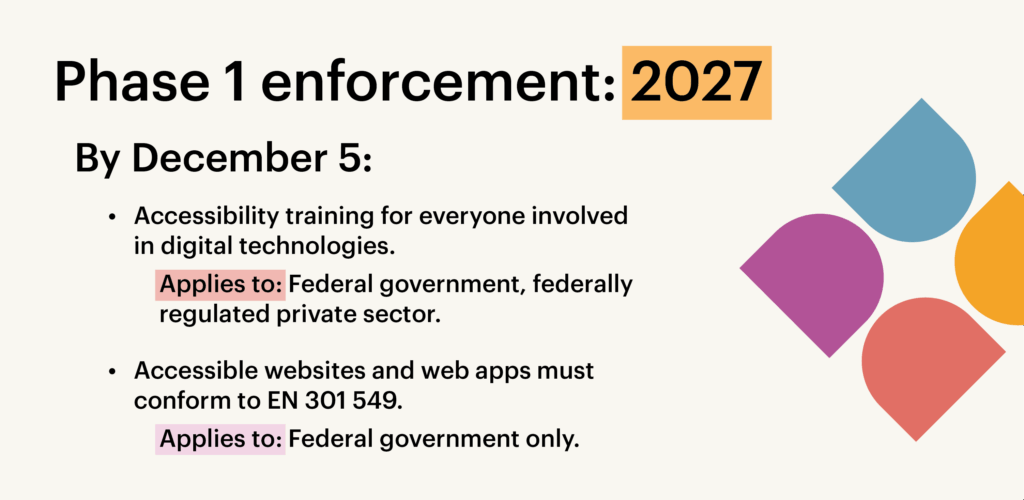
Phase 1 enforcement: The 2027 deadline. As reporting cycles continue, the new Digital Technologies Accessibility Regulations (Phase 1) introduce enforceable technical obligations. By December 5, 2027:
- Accessibility training. All obligated entities (federal government and federally regulated private sector) must complete mandatory accessibility training for all staff involved in digital technologies.
- Accessible websites and web apps
- Federal government only: Must ensure websites and web applications fully conform to the ICT Standard (EN 301 549) and publish their accessibility statement.
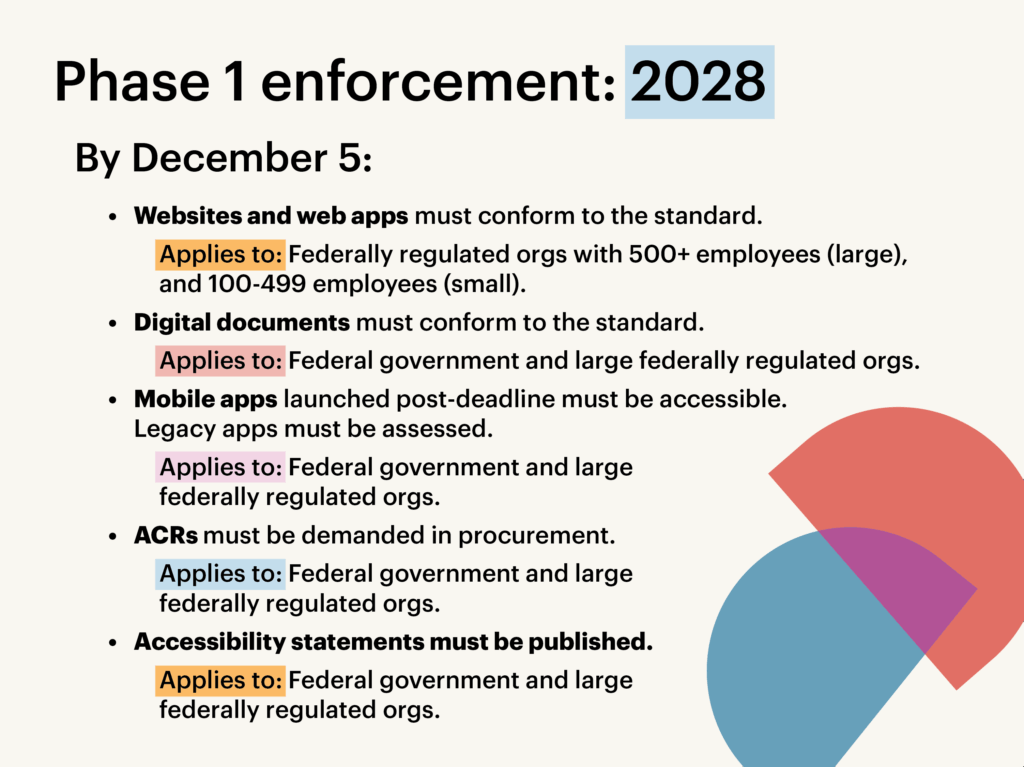
Phase 1 enforcement: The 2028 deadline. By December 5, 2028:
- Websites: Public-facing websites and web apps must conform to the standard
- Applies to federally regulated orgs with 500+ employees (large), and 100-499 employees (small).
- Digital documents: Digital documents (like PDFs) must conform to the standard
- For this phase, this requirement does apply to the federal government and large federally regulated orgs, but does not yet apply to medium orgs (100-499 employees).
- Mobile apps: New public-facing apps launched on or after this date must be accessible.
- For this phase, this requirement does apply to the federal government and large federally regulated orgs, but does not yet apply to medium orgs (100-499 employees).
- Legacy apps (existing before this date) must undergo a conformity assessment
- For this phase, this requirement does apply to the federal government and large federally regulated orgs, but does not yet apply to medium orgs (100-499 employees).
- Procurement and statements: You must begin demanding “clean” Accessibility Conformance Reports (ACRs) in procurement and publish your detailed accessibility statement
- For this phase, this requirement does apply to the federal government and large federally regulated orgs, but does not yet apply to medium orgs (100-499 employees).
As we closely compare how obligations and requirements differ by organization size, one question that emerges is whether there will be a Phase 2 requiring medium-sized organizations to meet the same requirements that large organizations are required to meet in Phase 1.
At Deque, we believe this will hit medium-sized organizations in a future Phase 2, despite no deadline having been set yet. However, because medium-sized businesses are already subject to the 2027 training deadline and may cross the 500-employee threshold in the interim, our strategic advice is to treat the ICT Standard (EN 301 549) as inevitable—even if there is no hard legal deadline yet.
Governance plus technical alignment drives success
Publishing plans and annual progress reports satisfies the structure of the ACA. It demonstrates that governance mechanisms are in place. But governance alone does not prove accessibility is operational.
Without alignment to CAN/ASC-EN 301 549, those plans and reports are difficult to defend. With a well-defined ICT accessibility standard, evaluation shifts from general commitment to measurable conformance.
This is where many organizations underestimate the lift. Accessibility cannot sit in a policy document or a compliance binder. It must be reflected in how technology is selected, designed, built, tested, and maintained.
That means embedding accessibility into procurement requirements and vendor contracts. It means aligning development workflows and design systems to the national ICT standard. It means validating against defined criteria, not informal checklists. And it means building internal competency through training and clear accountability.
If accessibility is not integrated into operational processes, reporting cycles will expose that gap. So remember, strong governance makes accessibility visible, while technical alignment makes it defensible.
The importance of being proactive
Remediating enterprise platforms, document repositories, and software systems is not a short-cycle effort. Embedding accessibility into procurement, vendor contracts, and SDLC practices requires executive sponsorship and budget alignment.
Organizations that begin now can spread this work across fiscal cycles. Those that wait until 2027 or 2028 will face compressed timelines, much higher remediation costs, and the risk of public reporting gaps.
Ultimately, this is about how seriously your organization takes digital accessibility, and how quickly it responds to enterprise-level changes.
You can approach these new reporting and enforcement cycles reactively, scrambling to demonstrate improvement, or strategically, aligning now to CAN/ASC-EN 301 549 and building a sustainable roadmap.
Strategic organizations plan ahead and avoid expensive, crisis-driven execution.
Next steps
The Accessible Canada Act created recurring accountability. The adoption of CAN/ASC-EN 301 549 created technical clarity. The Digital Technologies Accessibility Regulations introduce enforceable digital obligations beginning in 2027 and 2028. Together, they raise the maturity expectation for digital accessibility across federally regulated sectors.
If your roadmap is not yet aligned to Canada’s national ICT accessibility standard, and your next reporting or regulatory milestone falls within the next 6–24 months, now is the time to act.
You can schedule a strategic consultation today to pressure-test your timeline-to-compliance and ensure your next reporting cycle reflects measurable, defensible progress.