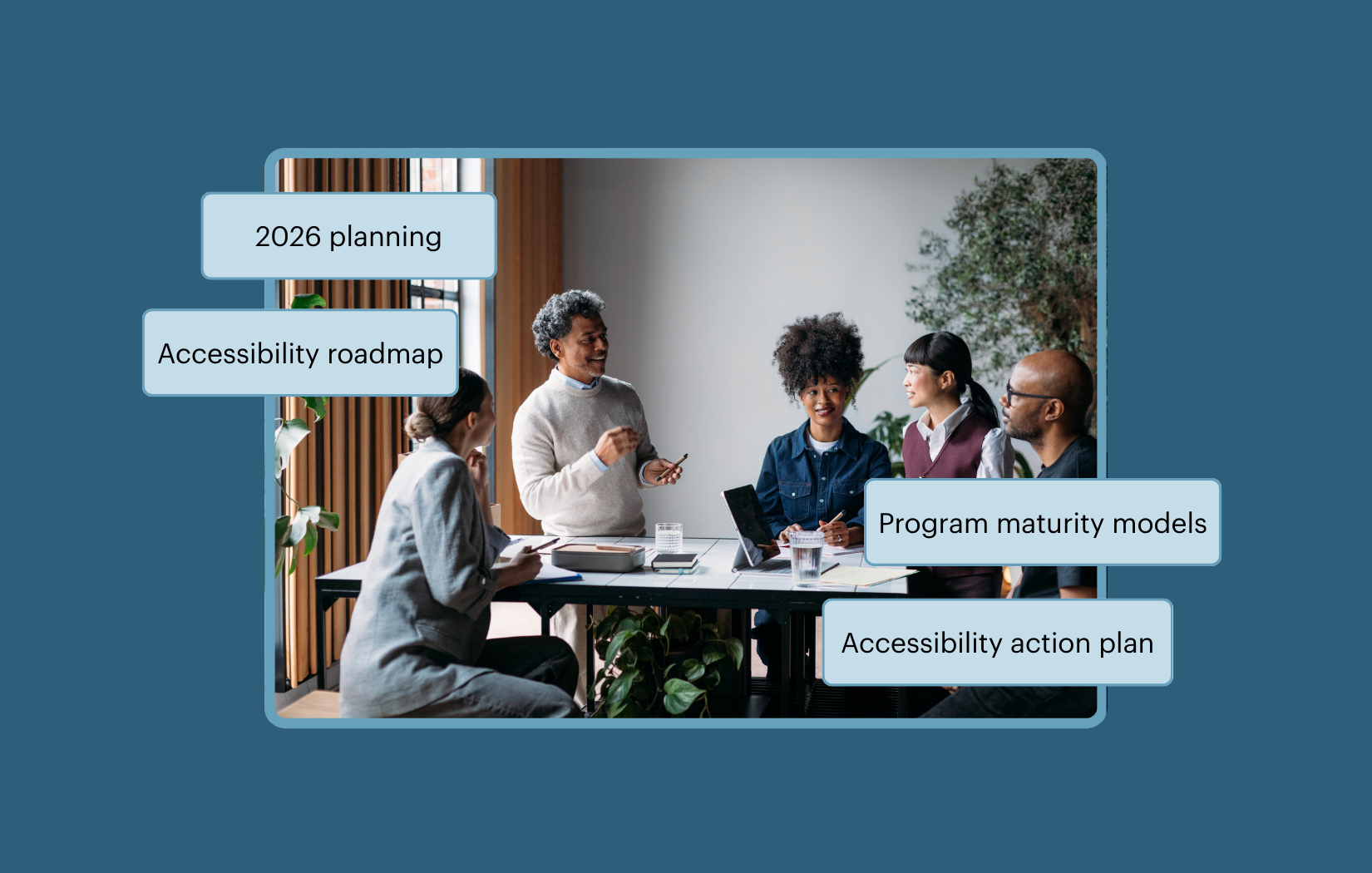
I recently had the opportunity to deliver a keynote, titled “Roadmap checkups: Ensure resiliency (PDF),” at the IAAP EU and Vially Accessibility Event in Dublin. My focus was on the importance of accessibility program roadmaps for long-term program success; specifically, I addressed how your roadmap must:
- Include a 3–5 year forward view
- Emphasize tasks with sufficient lead time for success
- Be robust, flexible, and positive
- Operate at an enterprise level
- Be rooted in measurement
In this post, I’ll go into greater detail on how to ensure that you’re optimizing your accessibility roadmaps. I’ll begin by explaining why checking in on your roadmap now is so critical.
You can experience my full keynote in this video:
Why are roadmaps and their checkups so important?
When organizations come to Deque for strategic consulting, one of the questions we ask is whether they have a 3–5-year accessibility program roadmap published at the enterprise or companywide level. In 2025, 50% of our respondents said that they didn’t have this type of roadmap. For those who did, only 15% said they’d reviewed it within the last 12 months. On a slightly more positive note, 25% said they’d reviewed it in the last 24 months.
This indicates that while many accessibility teams are working, they’re doing so without a documented plan or are unable to check in on the plans they do have. This leads us to believe that many organizations are in reactive mode and struggling to get ahead and escape the break-fix cycle.
We often encountered programs that were less mature than their organizations believed they were. To make our assessments, we use Deque’s Digital Accessibility Maturity Model (DAMM), which features a ratings scale that runs from “not started” to “optimized”:
0 – Not started
1 – Informed
2 – Defined
3 – Repeatable
4 – Monitor and Control
5 – Optimized
Through our analysis, we found that 95% of the accessibility programs we assessed were at maturity levels 0–2, while only 1% were firmly in level 3, the point at which a program shifts from reactive to proactive.
What we also saw in the data is that successful programs have roadmaps that drive maturity, with program administrators constantly checking to ensure they’re on track.
You need a mature accessibility program
Global accessibility is evolving rapidly. In Europe, the European Accessibility Act represents a once-in-a-generation regulatory inflection point that is all but certain to be a catalyst for similar regulatory actions around the world. In short, no matter where your organization is based, digital accessibility must be in your plans. Success means more growth and less risk. The alternative is fines and lawsuits, restrictions and penalties, exposure and brand damage.
To succeed, you must have a mature program. Compliance alone will fail at scale. There are simply too many interdependencies, from complex supply chains, self-service technologies, and mobile applications to PDF documentation, value chains, and more. Does your roadmap take all of this into consideration? The organizations that thrive will have accessibility built into every product, platform, process, and experience.
This can be a monumental endeavor. However, with a well-thought-out, published roadmap, your organization can achieve the program maturity needed for long-term success.
What you can do
There are several things you can be doing right now to optimize your roadmap and advance your program.
Analyze your roadmap
Roadmaps share common themes. They are aspirational, not inspirational. They incorporate sufficient lead time for success. And they cover aspects such as:
- Resilience. Your roadmap should be resilient enough to embrace emerging technologies such as AI. This includes having tasks to validate AI, training AI with responsible models, and leveraging AI where possible, including for advanced automated testing.
- Reporting. Your enterprise should be able to support all required regulatory reporting, including conformance reporting and nonconformance reporting. Many monitoring bodies do require you to submit a roadmap to conformity as part of your nonconformance reporting.
- Testing. You need to ensure that you’re testing to the right standard for the countries that you’re serving. Unfortunately, we see many companies attempting to claim conformance to EAA when they are only testing to WCAG 2.1 AA.
- Planning. You need to allocate ample time to ensure you can uplevel to EN 301 549 version 4.1.1 in the spring of 2026.
- Assessment. You should have a working definition of what “good” looks like in practice across your ecosystem for all personas, including vendors, buyers, and regulators.
- Management. Are you clearly defining roles and responsibilities using the RACI model to ensure everyone understands how they contribute?
Use proven methodologies from change management and motivation disciplines
Successful change management efforts use strategies like the following:
- Better goals through positivity. People prefer positive goals over negative statements. Use language like “Publish content that everyone can access,” or “Create documents that work with assistive technologies,” instead of “Don’t publish inaccessible content.”
- Specific yet flexible. People respond well to specificity, but they also appreciate flexibility. Rather than “Training must be complete by January 31,” use language like” Training should be aligned with individual schedules and completed within the first quarter.”
- Success as motivation. You can use evidence of success to increase motivation. Instead of “We have 100 documents to fix,” lead with “10 of our most trafficked documents are accessible.”
- Smaller is better. Focus on several smaller tasks instead of one big task. Instead of “We will fix all of our documents this year,” you can reframe the effort as, “We will aim to fix 10 documents from our inventory per month.”
Perhaps the most important thing about success is that you communicate it. Share the good news! Don’t just remove tick boxes or remove completed items from your list—report on them, show them in dashboards, and shout out your kudos wherever and however you can!
Engage the entire enterprise
It takes the entire enterprise working in concert to run a strong accessibility program. The effort must be frictionless, and every department must have a common approach and objective.
When programs struggle to mature—when they lose support, stall out, or backslide—it’s often because teams or departments are working in silos. For digital accessibility to be successful, everyone must work together. This goes well beyond the SDLC. Legal, procurement, regulatory reporting, risk and governance, learning and development, customer support, corporate communications—everyone must be aligned.
To achieve this alignment, you must socialize your roadmap before publication and recognize that this is a continuous activity. It’s how you ensure your roadmap is relatable to your colleagues and considers your entire organization’s inter- and intra-dependencies. Your roadmap should also be easy for anyone in your company to find. We recommend making it a key navigational item on your program’s portal or intranet. By making your roadmap easy to find, as well as its metrics for success, you provide one more avenue for the entire enterprise to be engaged.
Use common frameworks and methodologies
It is likely that your organization already uses SMART goals and the RACI model. Your accessibility program roadmap should also employ these models. It’s a way to avoid issues with measurability and competing definitions of success. It also establishes and fosters accountability, with teams having clearly defined roles and clear alignment with key objectives. To succeed within the business, you need to play the business game well!
Measure and report on everything you can, including program maturity
You are your own PR engine. Don’t be shy about broadcasting your achievements. Report every statistic you can, including overall program maturity. And remember, health measurements—completed using maturity models—can play a critical role in roadmap planning, success assessments, and storytelling.
Next steps
Deque has helped countless organizations increase their enterprise maturity model score using the approaches I’ve outlined above. It’s a proven framework, and if you have a roadmap in place, now is the perfect time to examine where and how you can optimize it for long-term success.
If you don’t yet have a roadmap in place, you can easily get the data you need to create one with our free digital accessibility action plan resource. It only takes a few minutes, and you’ll receive:
- A personalized action plan based on your organization’s current state
- Role-specific recommendations for designers, developers, and QA teams
- Clear ideas and next steps you can implement immediately
- Crucial advice across all phases of your SDLC
All you need to do is answer a quick series of questions about your accessibility practices, and we’ll generate a customized plan and deliver it straight to your inbox. Get your digital accessibility action plan today.
If you’re in Europe or doing business there, accessibility program maturity is already a mission-critical need for your organization. If you’re outside of Europe, now’s the time to get ahead, because heightened digital accessibility requirements are sure to be on the map for you as well.