
Overview: A large portfolio, a growing backlog
A large, billion-dollar media enterprise managing a substantial portfolio of digital properties set out to answer a question that is faced by most accessibility programs at scale: the work is known, the commitment is real but the capacity to execute never quite keeps pace. Maintaining Web Content Accessibility Guidelines (WCAG) compliance across dozens of properties while competing with roadmap priorities left accessibility backlogs growing faster than teams could address them.
The challenge: Can AI remediate accessibility issues end-to-end?
Following a comprehensive manual accessibility audit by Deque, the team identified 171 WCAG 2.2 AA accessibility issues across its digital properties. Addressing those issues required engineers to review findings, determine the correct fix, write code, create pull requests, and shepherd changes through review—an effort estimated at approximately 257 engineering hours, or roughly five weeks of work and more than $25,000 in remediation costs.
The team set out to answer an important question: could an AI agent handle remediation end-to-end, with minimal manual support?
The approach: Agents remediate, engineers review
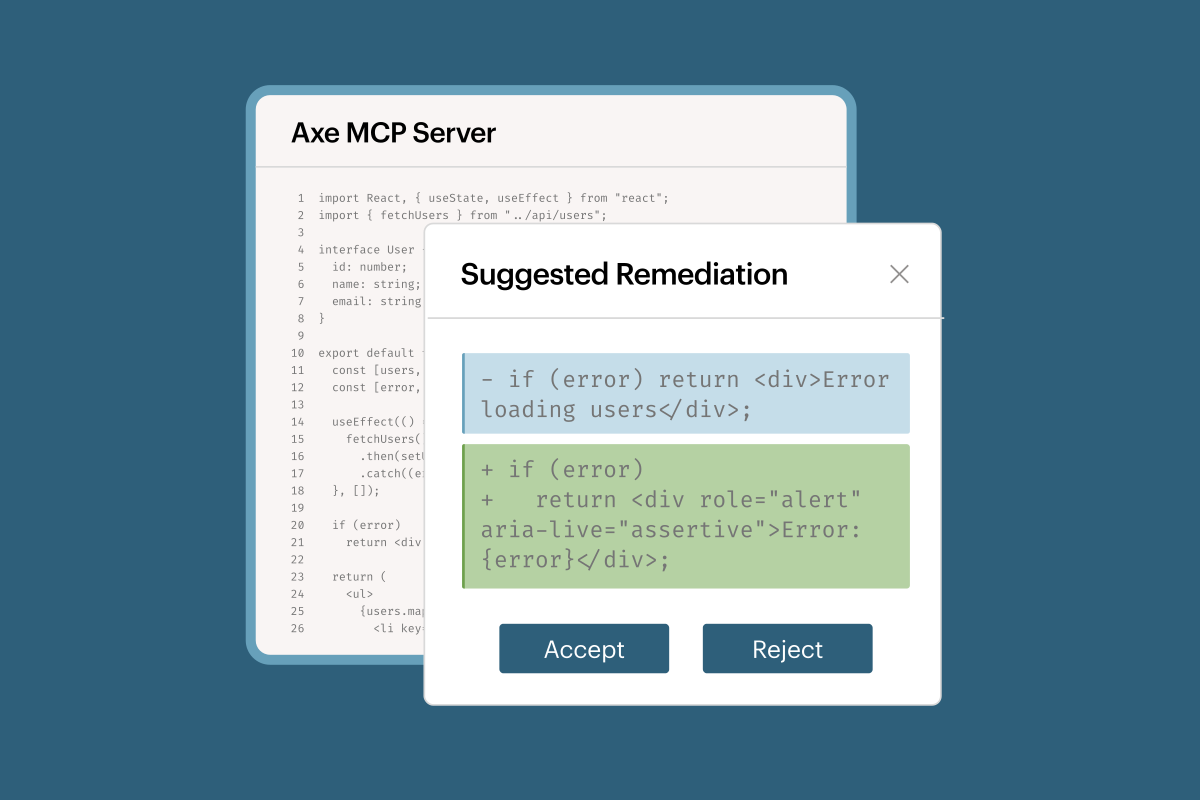
The team built the entire agentic workflow in less than an hour, integrating the Axe MCP Server into its existing engineering process. Axe MCP Server is a Deque tool that brings Axe Platform expertise into AI coding agents. Rather than using AI as a developer assistant that suggests fixes, they designed the workflow so remediation happened automatically:
- Accessibility findings were provided to an AI agent.
- The agent used the remediate tool to apply the expected HTML fix directly to source code.
- Pull requests were automatically created and documented.
The engineer’s role in this model shifted significantly, from manually writing remediation code to reviewing AI-generated changes, approving pull requests, and governing overall quality and outcomes. The result was not simply faster remediation; it was a fundamentally different operating model for accessibility work.
The impact: 253 engineering hours returned
The team applied the workflow to 171 WCAG 2.2 AA accessibility issues—work that was estimated to require 257 engineering hours, was cut down to 4. The results speak for themselves:
- 80% of applicable accessibility issues were successfully remediated and validated end-to-end, with 70% requiring no human edits and 10% requiring only light human review
- 98% faster remediation
- The agent extended remediation beyond the original scope by identifying and fixing duplicate accessibility issues across additional pages through a broader VPAT sweep
- Based on internal estimates, the workflow saved more than $25,000 in engineering costs.
The result was faster remediation, allowing engineers to focus primarily on validation, governance, and quality oversight rather than manual implementation.
Looking ahead
The team continues to process additional accessibility issues through the workflow, with current focus on expanding detection coverage and improving remediation performance. These results point to a meaningful shift in what’s possible: when agentic workflows absorb the majority of remediation work, engineering capacity that once went toward backlog maintenance can be freed for product development, quality improvements, and the accessibility decisions that genuinely require human judgment. For organizations facing similar accessibility demands, this demonstrates a practical path toward making accessibility a continuous engineering capability rather than a recurring remediation project.
