Happy 15th Global Accessibility Awareness Day (GAAD)! Or, should we say, GAAD afternoon!
Seriously, what a special day this is, as everyone from lifetime advocates to first-time explorers are coming together around the world to create awareness about accessibility. Thank you all for being a part of this.
Here at Deque, we’ve been having an amazing time with our three free digital accessibility training sessions. We’ve welcomed guests in the Asia-Pacific (APAC) region, in Europe, and in North America.
Here is just a quick recap of our three events:
Digital accessibility fundamentals training: Europe
Turnout for this event was incredible. Thousands of registrants, from over 30 different countries, ranging all the way from Argentina, Austria, and Belgium to Turkey, Ukraine, and the United Kingdom! Geography wasn’t the only diversity on display, either. We had guests representing more than 30 different job roles, running the gamut from Accessibility Specialists, Admin Assistants, Business Analysts, and Developers to Solution Consultants, Teachers, UX Writers, and Web Content Officers.
One of the things we enjoy most about these sessions is all the questions that come in, and all the feedback we receive. Getting a response like the one below just makes it really clear how important it is that we come together to learn from one another as often as we can:
“Thanks for the demo, Patrick. While I’ve recently had JAWS training in my role, testing websites as a sighted person doesn’t quite convey the same experience. Seeing a blind user navigate a website using JAWS was incredibly impactful and really brought home just how critical it is to ensure our websites are fully accessible.”
Patrick, in this case, is Patrick Sturdivant, Vice President and Principal Strategy Consultant at Deque. As an experienced accessibility professional who is blind, he is uniquely positioned to offer powerful insight and experience. (If you haven’t read his articles on traveling internationally as a person with a disability, you’re in for a very entertaining education!). Patrick was joined by Ron Beenen (Director of European Business Development, Deque), and Natalie Russell (Enterprise Customer Success Manager, Deque).
In addition to the above, we had some other fantastic feedback as well. One individual who was clearly gearing up for an important accessibility conversation wrote in the chat: “Thank you so much, all, I really enjoyed that, and thank you in advance for support on the overlay battle!” Another attendee added a lovely note of appreciation for event host Natalie Russell, Enterprise Customer Success Manager at Deque: “Thank you all, and thank you, Natalie, for your heart-warming energy 🙂 Have a great day!”
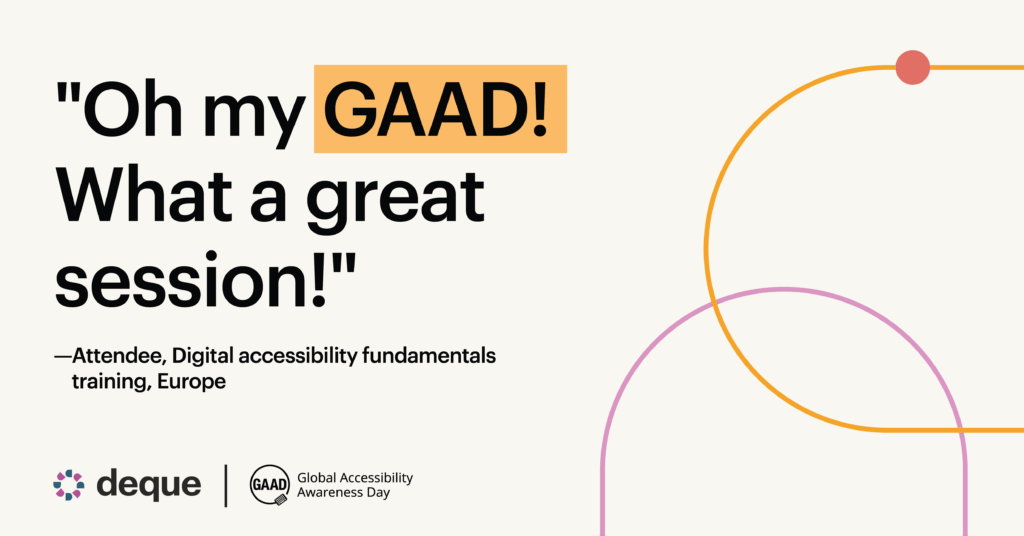
We think the award for the cleverest attendee comment should probably go to this one: “Oh my GAAD! What a great session!”:
Over the course of two hours, our Deque experts shared a wealth of insights and information, and their unique perspectives combined to offer a comprehensive look at the foundations of digital accessibility as a practice.
Whether it was Patrick reminding everyone that everyone can make a difference …
“You don’t have to be an Apple or a Microsoft to have a website that’s inclusive of everyone. You just have to have a little thought.” —Patrick Sturdivant, Vice President and Principal Strategy Consultant, Deque
… or Ron Beenen encouraging cross-functional awareness and action …
“Accessibility is an organization-wide topic, and it’s really about organizational change.” —Ron Beenen, Director of European Business Development, Deque
… or Natalie Russell providing clear tactical guidance …
“The combination of automated tools, manual expert testing, and real user feedback is how you save money, time, and, more importantly, build products that truly work for everyone.” —Natalie Russell, Enterprise Customer Success Manager, Deque
… it was a session full of meaningful learning for all.
Digital accessibility fundamentals training: North America
She probably won’t want us to call her name out specifically—she’s just that kind of team player!—but the person responsible for all the behind-the-scenes work to make these events happen had a delightful summary of the North America training session: “North American GAAD went smashingly!”
With thousands of people registered, we certainly can’t argue with her. And they came from all over the region—all the way from Abbotsford, British Columbia, Anchorage, Alaska, and Atlanta, Georgia to Toronto, Ontario, Tuscaloosa, Alabama, and Tyler, Texas.
And with over 100 questions posed by attendees, our Deque experts were very busy. Patrick Sturdivant, mentioned above, was joined for this session by Michael Harshbarger, Strategic Accessibility Training Consultant here at Deque.
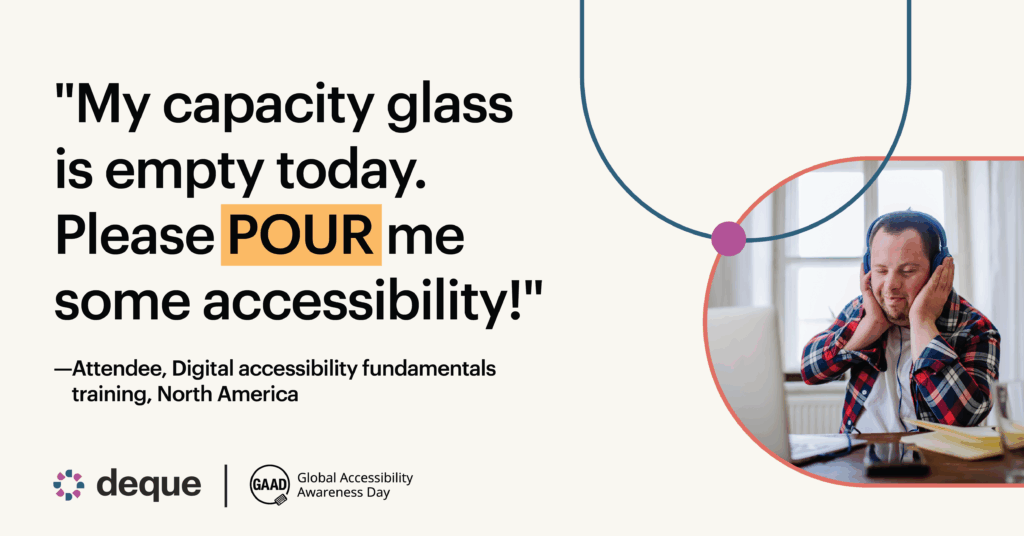
As with the Europe session, we had some great comments in the chat, and we agree we’ve got another clear winner for the most creative comment: “My capacity glass is empty today. Please POUR me some accessibility!”
As to the perspectives shared by our experts, it’s safe to say they took the “fundamental training” mantra seriously, delivering foundational insights such as this one from Patrick:
“Digital accessibility is all about ensuring that all people of all abilities can use, understand, operate, and consume digital content, no matter what their ability is.”
Or this revealing observation from Michael:
“Guess what the number one use piece of assistive technology is in the world? This thing right here, the keyboard.”
Part of what makes sessions like these so valuable is that they’re geared toward practical guidance. For example, one attendee asked, “Can you describe how you like Alt Text to be descriptive?” Patrick’s response was, “Don’t try to please everyone. You will never please everyone with your Alt Text. But any Alt Text is appreciated over no Alt Text.” Coming from someone who is blind and uses assistive technology, and is also an accessibility professional, that’s real-world guidance you can really use.
In addition to covering the fundamentals, the conversations did expand into some broader territory. At one point, Michael discussed where digital accessibility sits as a business priority, stating that, “Accessibility is no different than security or performance … you wouldn’t do security once and say we’re done.” This is something Deque founder and CEO Preety Kumar recently wrote about in an article titled Elevating digital accessibility from optional to essential. In that piece, she wrote: “The vision is there. The momentum is real. And now, we have the tools and the processes to make it easy—to create a world where digital accessibility is simply how we build.”
As is often the case when discussing digital accessibility these days, artificial intelligence (AI) came up in the conversations, and it was here that Patrick offered perhaps the most memorable guidance: “Respect AI, understand AI, manage AI. But remember, you’re in control, and you’re still responsible for your AI code to be accessible.”
Digital accessibility fundamentals training: APAC
Our APAC digital accessibility fundamentals training session featured many of the same hallmarks as our other two sessions, including geographic diversity (Australia, India, Indonesia, New Zealand), role variety (from Software Testers and Disability Inclusion Associates to QA experts and Product Designers), and tons of registrants. We’re very excited to see momentum continuing to build in the region.
Our Deque host was Aparna Pasi, our VP of Professional Services. She was joined by Gerry Neustatl, the founder of AccessUX. Gerry is an accessibility leader with 20+ years of experience leading digital transformation across the enterprise and government sectors. Prior to AccessUX, he contributed 10 years to shaping accessibility and inclusive design culture at the Australian Broadcasting Corporation (ABC), home to some of Australia’s most trusted media brands.
Needless to say, we were thrilled to have Gerry join us on behalf of our registered attendees!
We also had some very valuable contributions from members of our community. When learning about accessibility, it’s vital to hear from people who have disabilities. Jamie Knight is a research engineer from the BBC who identifies as a person with autism. He had the following to share:
“When we come to a web page, there’s a certain amount of energy we have. And if we can’t complete what we’ve got to do with the energy we have at that moment—our capacity so to speak—it simply won’t get done. So the idea of an obstacle course or some sort of challenge to overcome is a very good analogy.”
David Fazio, who is the founder of the Helix Opportunity, a disability-related business and organizational development consultancy firm that was funded by the California Department of Rehabilitation, has a traumatic brain injury (or TBI). He shared his observations about how he experiences the web:
“It gets to the point where I get so frustrated that if I can’t find my way around navigating a web page to see where things are, it sort of kind of shuts my brain down and kind of makes it hard for me to operate psychologically. So what I’ll do is I’ll step away from it and I’ll say, ‘Okay, I’ll do this later.’ But then the short-term memory loss kicks in, and I don’t remember to do it. And sometimes I’ll miss deadlines to apply for something, to register for a conference, a sale to buy an item. So if that happens, that organization, that company, that business loses out.”
As with our other sessions, the focus was on fundamentals, and in addition to the human element, that also means data. Here are some important global numbers we shared during our APAC session:
- Over 1.3 billion people, that is 20% of the world’s population (1 in 6 people), self-identify as having a disability.
- Over 253 million people worldwide have some form of blindness or visual disability (3.2% of the world’s population).
- 466 million people have deafness or hearing loss (6%).
- About 200 million people have a cognitive disability (2.6%).
- 75 million people use a wheelchair daily.
Of course, with this being a session for APAC, this is perhaps the most important statistic of them all: 690 million people in APAC have disabilities.
Ultimately, GAAD is about awareness. As to why we chose to participate by hosting these training sessions, it’s because we hope to build a bridge from awareness to action, helping people convert what they learn into what they want to do. While the global accessibility community has made huge strides in the previous decades, our work is not finished, and the more allies and advocates we can empower, the more quickly we can achieve our shared mission of digital equality.
Which is why a quote like this is so powerful: “It is always exciting to join an event like this. I’m looking to contribute to this field.”
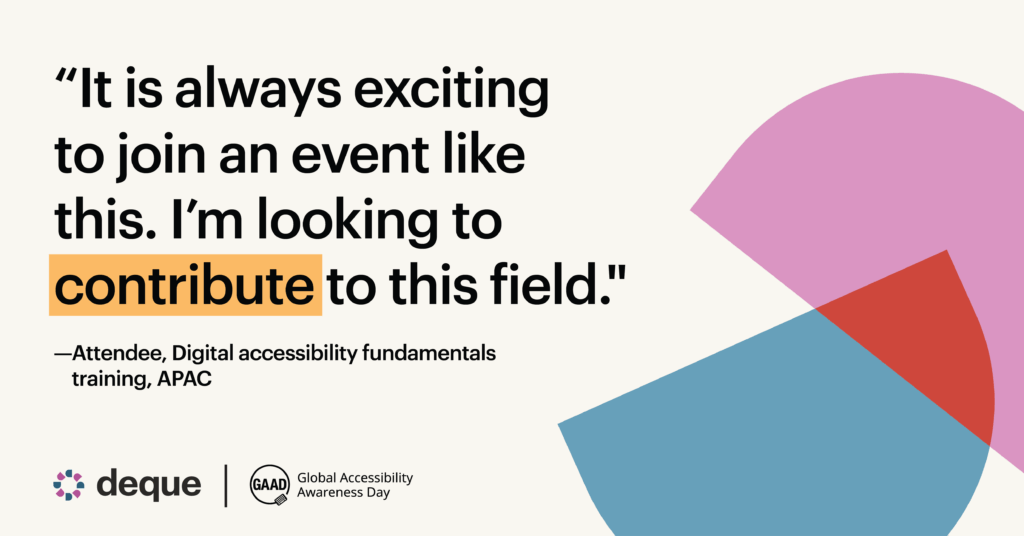
It may seem like a simple, straightforward sentiment, but to us, that second sentence is magic. If there’s one thing we hope these sessions produce, it’s momentum.
And so we say to every training session attendee, thank you! Thank you, and please do contribute. Contribute your passion and your awareness. Contribute your knowledge and your desire to learn. Contribute with your heart and your mind. We need you. The global accessibility community needs you. People with disabilities need you.
The world needs you.
Happy GAAD, and we’ll look forward to celebrating year 16 with you this time next year!