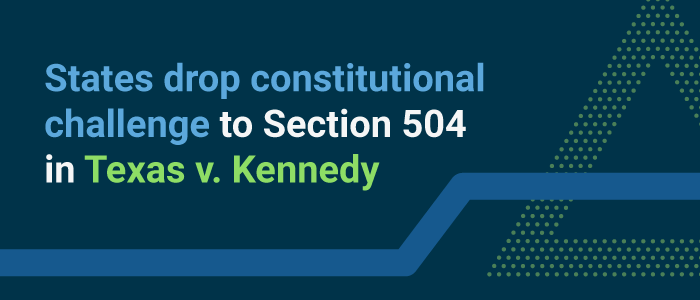
Le 11 avril 2025, un événement majeur s'est produit dans le cadre du procès en cours Texas c. Kennedy (anciennement Texas c. Becerra), une affaire intentée par l’État du Texas et 16 autres États contestant la mise à jour de la réglementation relative à l’article 504 par le ministère américain de la Santé et des Services sociaux (HHS).
Dans un rapport conjoint sur l'état d'avancement de l'affaire déposé auprès du tribunal, les plaignants ont précisé qu'ils ne demandaient pas une décision déclarant inconstitutionnelle la section 504 de la loi sur la réadaptation (Rehabilitation Act) ni empêchant son application par le ministère américain de la Santé et des Services sociaux (HHS). Cela élimine une menace juridique importante pour les droits des personnes en situation de handicap.
Plus précisément, le chef d'accusation n° 3 de la plainte initiale, qui affirmait que « l'article 504 est inconstitutionnel », a été retiré. Si cette allégation avait été retenue, elle aurait pu remettre en cause les protections de longue date en matière de droits civils dont bénéficient les personnes en situation de handicap dans le cadre des programmes et services financés par le gouvernement fédéral. Heureusement, cela n'a pas été le cas.
Toutefois, certaines questions restent en suspens. Bien que le recours constitutionnel ait été abandonné, la procédure judiciaire se poursuit. Les questions juridiques restantes portent sur la manière dont le ministère américain de la Santé et des Services sociaux (HHS) a élaboré ses mises à jour de 2024 du règlement relatif à l’article 504, et plus particulièrement sur la manière dont ces mises à jour s’appliquent concrètement aux programmes publics, aux services numériques et aux établissements de santé.
Qu'est-ce que l'article 504 ?
Pour comprendre pourquoi cette évolution juridique est si importante, revenons brièvement sur ce qu’est l’article 504 et sur ce qu’il couvre.
L'article 504 de la loi sur la réadaptation de 1973 (Rehabilitation Act) est une loi fondamentale en matière de droits civils qui interdit toute discrimination fondée sur le handicap dans tout programme ou toute activité bénéficiant d'une aide financière fédérale. Cela concerne notamment les établissements scolaires, les hôpitaux, les organismes publics régionaux et locaux, ainsi que les organisations à but non lucratif — publiques ou privées — dès lors qu'elles reçoivent des fonds provenant d'agences fédérales telles que le ministère américain de la Santé et des Services sociaux (HHS).
En vertu de l'article 504, les organisations doivent veiller à ce que les personnes en situation de handicap bénéficient d'un accès égal aux services, aux prestations et aux programmes.
En vertu de l'article 504, les organismes doivent veiller à ce que les personnes en situation de handicap bénéficient d'un accès égal aux services, aux prestations et aux programmes. Cela comprend notamment :
- Accessibilité physique des bâtiments et des équipements
- Une communication efficace (par exemple, interprètes, formats alternatifs)
- Accessibilité des programmes grâce à la politique, aux effectifs et aux procédures
- Accessibilité numérique des sites web, des applications mobiles, des bornes interactives et d'autres systèmes informatiques
Contrairement à l'ADA, dont le champ d'application est plus large, l'article 504 est spécifiquement lié aux financements fédéraux — mais les exigences en matière d'accessibilité sont similaires.
L'article 504 aborde également de manière spécifique des questions telles que les exigences d'accessibilité applicables aux outils internes utilisés par les employés, un sujet que j'ai brièvement évoqué dans un récent article consacré au titre II de l'ADA:
En vertu de l'article 504 de la loi sur la réadaptation (Rehabilitation Act), tout organisme bénéficiant d'un financement fédéral doit veiller à ce que ses programmes et ses outils soient accessibles aux salariés en situation de handicap. Cela signifie que les outils internes, tels que les sites web destinés aux salariés, les portails de formation et autres ressources en ligne, doivent être utilisables par tous, y compris les personnes qui ont recours à des lecteurs d'écran ou à d'autres technologies d'assistance.
Pourquoi l'article 504 est-il important ?
L'article 504 reste une pierre angulaire des droits civils des personnes handicapées aux États-Unis. Cette clarification apportée dans l'affaire Texas c. Kennedy préserve les fondements de cette loi, alors même que le débat juridique se poursuit quant à son application.
Pour les agences et les organisations qui se préparent à la mise en œuvre et à la mise en conformité, cette décision confirme que l'article 504 est là pour durer.
Deque continuera à suivre l'évolution de cette affaire et à communiquer les informations pertinentes concernant l'accessibilité numérique et l'inclusion des personnes en situation de handicap dans les services publics et gouvernementaux.
Si vous avez des questions à ce sujet ou sur d'autres questions juridiques et de conformité, n'hésitez pas à prendre rendez-vous dès aujourd'hui pour une consultation gratuite avec Deque .