[Note de la rédaction : une version mise à jour de cette infographie est disponible à l'adressehttps://accessibility.deque.com/essential-guide-digital-accessibility]
Pas moins de 57 millions d’Américains vivent avec un handicap, et beaucoup d’entre eux ont des difficultés à naviguer sur Internet. L’accessibilité numérique ne cesse d’évoluer pour répondre aux besoins de cette population en pleine croissance. Ne restez pas à la traîne ! Consultez notre infographie très pratique – le Guide essentiel de l'accessibilité numérique – pour en savoir plus, et découvrez comment Deque peut vous aider à gérer les risques grâce à des outils adaptés. De plus, consultez notre version HTML accessible sous l'infographie, ou téléchargez le guide essentiel pour plus de commodité.
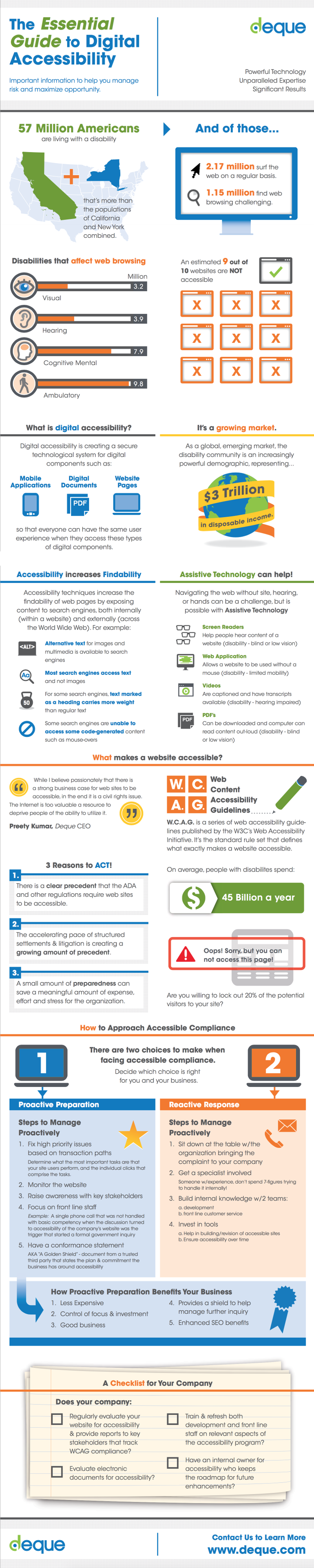
Infographie – Le guide indispensable de l'accessibilité numérique
57 millions d'Américains
vivent avec un handicap.
C'est plus que la population de la Californie et de New York réunies.
Et parmi ceux-là…
- 2,17 millions de personnes naviguent régulièrement sur Internet.
- 1,15 million de personnes ont des difficultés à naviguer sur Internet.
- On estime que 9 sites web sur 10 ne sont PAS accessibles
Handicaps affectant la navigation sur Internet
- 3,2 millions de vues
- Audience : 3,9 millions
- Cognitive Mental 7,9 millions
- Soins ambulatoires : 9,8 millions
Qu'est-ce que l'accessibilité numérique ?
L'accessibilité numérique consiste à mettre en place un système technologique sécurisé pour les éléments d'
s numériques,
tels que : les applications mobiles, les documents numériques et les pages de sites web.
Afin que chacun puisse bénéficier de la même expérience utilisateur lorsqu'il accède à ce type de composants numériques.
C'est un marché en pleine croissance.
En tant que marché mondial émergent, la communauté des personnes en situation de handicap constitue un groupe démographique de plus en plus influent, représentant 3 000 milliards de dollars de revenu disponible.
Une meilleure accessibilité facilite la recherche
Les techniques d'accessibilité améliorent la visibilité des pages Web en rendant leur contenu accessible aux moteurs de recherche, tant en interne (au sein d'un site Web) qu'en externe (sur l'ensemble du Web). Par exemple :
- Les moteurs de recherche ont accès au texte alternatif des images et des contenus multimédias
- La plupart des moteurs de recherche indexent le texte et non les images
- Pour certains moteurs de recherche, le texte identifié comme titre a plus de poids
- que le texte normal
- Certains moteurs de recherche ne parviennent pas à accéder à certains contenus générés par du code, tels que les effets « mouse-over ».
Les technologies d'assistance peuvent vous aider !
Naviguer sur Internet sans voir, sans entendre et sans les mains peut représenter un défi, mais c'est possible grâce aux technologies d'assistance.
- Lecteurs d'écran : permettent aux personnes de « entendre » le contenu d'un site web (handicap : cécité ou malvoyance)
- Application web : permet d'utiliser un site web sans souris (handicap – mobilité réduite)
- Vidéos : elles sont sous-titrées et accompagnées de transcriptions (handicap – déficience auditive)
- Fichiers PDF : peuvent être téléchargés et leur contenu peut être lu à voix haute par un ordinateur (personnes en situation de handicap – aveugles ou malvoyantes)
Qu'est-ce qui rend un site web accessible ?
Même si je suis fermement convaincu que l'accessibilité des sites web présente un intérêt économique indéniable, il s'agit en fin de compte d'une question de droits civiques. Internet est une ressource trop précieuse pour priver qui que ce soit de la possibilité de l'utiliser.
Preety Kumar, PDG d'Deque
3 raisons d'AGIR !
- Il existe un précédent clair selon lequel l'ADA et d'autres réglementations exigent que les sites web soient accessibles.
- L'accélération du rythme des règlements échelonnés et des litiges génère un nombre croissant de précédents.
- Un minimum de préparation peut permettre à l'organisation d'économiser des sommes non négligeables, de réduire considérablement ses efforts et de limiter son stress.
Directives pour l'accessibilité des contenus Web
Les W.C.A.G. constituent une série de directives relatives à l'accessibilité du Web publiées par l'Initiative pour l'accessibilité du Web (WAI) du W3C. Il s'agit de l'ensemble de règles standard qui définit précisément ce qui rend un site Web accessible.
En moyenne, les personnes en situation de handicap dépensent 45 milliards de dollars par an
Oups ! Désolé, mais vous ne pouvez pas accéder à cette page !
Êtes-vous prêt à exclure 20 % des visiteurs potentiels de votre site ?
Comment aborder la conformité en matière d'accessibilité
En matière de conformité aux normes d'accessibilité, deux choix s'offrent à vous.
Choisissez l'option qui vous convient le mieux, à vous et à votre entreprise.
1. Préparation proactive
Étapes pour une gestion proactive :
- Résolvez les problèmes hautement prioritaires en vous basant sur les parcours de transaction.
Identifiez les tâches les plus importantes effectuées par les utilisateurs de votre site, ainsi que les clics individuels qui composent ces tâches. - Surveiller le site web
- Sensibiliser les principales parties prenantes
- Mettre l'accent sur le personnel de première ligne.
Exemple : un simple appel téléphonique qui n'a pas été traité avec le minimum de compétence lorsque la conversation a porté sur l'accessibilité du site web de l'entreprise a été l'élément déclencheur d'une enquête officielle menée par les pouvoirs publics. - Disposer d'une déclaration de conformité.
Également appelée « Bouclier d'or » : document émanant d'un tiers de confiance qui présente la stratégie et l'engagement de l'entreprise en matière d'accessibilité.
2. Réponse réactive
Étapes pour une gestion proactive :
- Asseyez-vous à la table des négociations avec l'organisation qui a déposé la plainte auprès de votre entreprise.
- Faites appel à un spécialiste.
Quelqu'un qui a de l'expérience : ne dépensez pas des millions pour essayer de gérer cela en interne ! - Développer les compétences en interne avec deux équipes :
- développement
- service client de première ligne.
- Investissez dans des outils.
- Aide à la création et à la mise à jour de sites accessibles
- Garantir l'accessibilité à long terme
Les avantages d'une préparation proactive pour votre entreprise
- Moins cher
- Maîtrise des priorités et des investissements
- Une bonne affaire
- Offre une protection permettant de mieux gérer les demandes d'informations complémentaires
- Avantages accrus en matière de référencement naturel (SEO)
Une liste de contrôle pour votre entreprise
Votre entreprise :
- Évaluez-vous régulièrement l'accessibilité de votre site web et fournissez-vous aux principales parties prenantes des rapports permettant de suivre la conformité aux WCAG?
- Évaluer l'accessibilité des documents électroniques ?
- Former et actualiser les connaissances du personnel de développement et du personnel de première ligne sur les aspects pertinents du programme d'accessibilité ?
- Y a-t-il un responsable interne chargé de l'accessibilité qui gère la feuille de route des améliorations futures ?