[Anmerkung der Redaktion: Eine aktualisierte Version dieser Infografik ist unterhttps://accessibility.deque.com/essential-guide-digital-accessibility verfügbar.]
Ganze 57 Millionen Amerikaner leben mit einer Behinderung, und für viele von ihnen ist das Surfen im Internet eine Herausforderung. Die digitale Barrierefreiheit entwickelt sich ständig weiter, um den Anforderungen dieser wachsenden Bevölkerungsgruppe gerecht zu werden. Lassen Sie sich nicht zurückfallen! Werfen Sie einen Blick auf unsere coole Infografik – den „Essential Guide to Digital Accessibility“ – für weitere Informationen und erfahren Sie, wie „ Deque “ Ihnen helfen kann, Risiken mit den richtigen Tools zu bewältigen. Sehen Sie sich außerdem unsere barrierefreie HTML-Version unterhalb der Infografik an oder laden Sie den Leitfaden ganz bequem herunter.
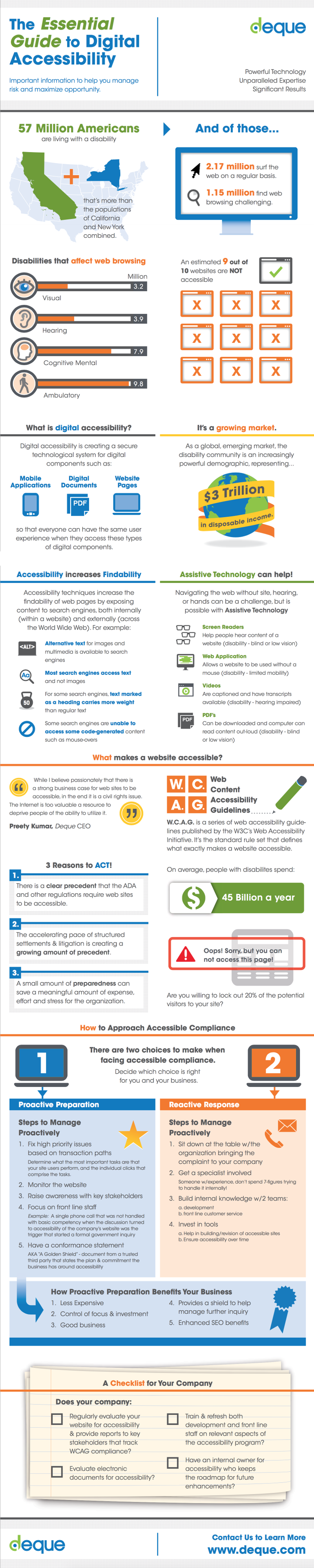
Infografik – Der unverzichtbare Leitfaden zur digitalen Barrierefreiheit
57 Millionen Amerikaner
mit einer Behinderung leben.
Das ist mehr als die Einwohnerzahlen von Kalifornien und New York zusammen.
Und von diesen…
- 2,17 Millionen Menschen surfen regelmäßig im Internet.
- 1,15 Millionen Menschen empfinden das Surfen im Internet als schwierig.
- Schätzungsweise 9 von 10 Websites sind NICHT barrierefrei
Behinderungen, die das Surfen im Internet beeinträchtigen
- Bild 3,2 Millionen
- Zuhörer: 3,9 Millionen
- Kognitive und psychische Erkrankungen 7,9 Millionen
- Ambulant 9,8 Millionen
Was versteht man unter digitaler Barrierefreiheit?
Digitale Barrierefreiheit bedeutet die Schaffung eines sicheren technologischen Systems für digitale
Komponenten wie: mobile Anwendungen, digitale Dokumente, Webseiten.
Damit jeder beim Zugriff auf diese Art von digitalen Komponenten die gleiche Benutzererfahrung hat.
Es ist ein wachsender Markt.
Als globaler, aufstrebender Markt stellt die Gruppe der Menschen mit Behinderung eine zunehmend einflussreiche Bevölkerungsgruppe dar, die über ein verfügbares Einkommen von 3 Billionen US-Dollar verfügt.
Eine bessere Barrierefreiheit verbessert die Auffindbarkeit
Techniken zur Barrierefreiheit verbessern die Auffindbarkeit von Webseiten, indem sie Inhalte für Suchmaschinen sichtbar machen – sowohl intern (innerhalb einer Website) als auch extern (im gesamten World Wide Web). Zum Beispiel:
- Für Suchmaschinen stehen Alternativtexte für Bilder und Multimedia-Inhalte zur Verfügung
- Die meisten Suchmaschinen greifen auf Text zu, nicht auf Bilder.
- Bei einigen Suchmaschinen wird Text, der als Überschrift gekennzeichnet ist, stärker gewichtet
- als normaler Text
- Einige Suchmaschinen können auf bestimmte programmgesteuerte Inhalte, wie z. B. Mouseover-Effekte, nicht zugreifen.
Hilfstechnologie kann helfen!
Das Surfen im Internet ohne Seh-, Hör- oder Tastvermögen kann eine Herausforderung sein, ist aber mit Hilfe von assistiver Technologie möglich.
- Bildschirmleseprogramme: Helfen Menschen dabei, den Inhalt einer Website zu hören (Behinderung – Blindheit oder Sehbehinderung)
- Webanwendung: Ermöglicht die Nutzung einer Website ohne Maus (Behinderung – eingeschränkte Mobilität)
- Videos: Sind mit Untertiteln versehen und es liegen Transkripte vor (Behinderung – Hörbehinderung)
- PDFs: Können heruntergeladen werden, und der Computer kann den Inhalt vorlesen (Behinderung – Blindheit oder Sehbehinderung)
Was macht eine Website barrierefrei?
Auch wenn ich fest davon überzeugt bin, dass es gute wirtschaftliche Gründe dafür gibt, Websites barrierefrei zu gestalten, handelt es sich letztendlich doch um eine Frage der Bürgerrechte. Das Internet ist eine zu wertvolle Ressource, als dass man Menschen die Möglichkeit vorenthalten dürfte, es zu nutzen.
Preety Kumar, Geschäftsführerin v Deque
3 Gründe, zu HANDELN!
- Es gibt einen eindeutigen Präzedenzfall dafür, dass das ADA und andere Vorschriften vorschreiben, dass Websites barrierefrei sein müssen.
- Das immer schnellere Tempo bei strukturierten Vergleichen und Rechtsstreitigkeiten führt zu einer wachsenden Zahl von Präzedenzfällen.
- Schon ein wenig Vorarbeit kann dem Unternehmen erhebliche Kosten, Aufwand und Stress ersparen.
Richtlinien zur Barrierefreiheit von Webinhalten
W.C.A.G. ist eine Reihe von Leitlinien zur Barrierefreiheit im Web, die von der Web Accessibility Initiative des W3C veröffentlicht wurden. Es handelt sich dabei um einen Standard-Regelsatz, der genau definiert, was eine Website barrierefrei macht.
Im Durchschnitt geben Menschen mit Behinderungen jährlich 45 Milliarden Dollar aus
Hoppla! Tut mir leid, aber du kannst diese Seite nicht aufrufen!
Sind Sie bereit, 20 % der potenziellen Besucher Ihrer Website auszuschließen?
Wie man die Einhaltung der Barrierefreiheitsvorschriften angeht
Im Hinblick auf die Einhaltung der Barrierefreiheitsvorschriften gibt es zwei Möglichkeiten.
Entscheiden Sie, welche Option für Sie und Ihr Unternehmen die richtige ist.
1. Vorausschauende Vorbereitung
Schritte zum proaktiven Umgang:
- Beheben Sie Probleme mit hoher Priorität anhand von Transaktionspfaden.
Ermitteln Sie, welche Aufgaben die Nutzer Ihrer Website am häufigsten ausführen und aus welchen einzelnen Klicks sich diese Aufgaben zusammensetzen. - Die Website überwachen
- Sensibilisierung der wichtigsten Interessengruppen
- Der Fokus liegt auf den Mitarbeitern mit Kundenkontakt.
Beispiel: Ein einziger Telefonanruf, der nicht mit der erforderlichen Kompetenz bearbeitet wurde, als das Gespräch auf die Barrierefreiheit der Unternehmenswebsite kam, war der Auslöser für eine offizielle behördliche Untersuchung. - Legen Sie eine Konformitätserklärung vor.
Auch bekannt als „A Golden Shield“ – ein Dokument einer vertrauenswürdigen dritten Partei, in dem der Plan und das Engagement des Unternehmens im Bereich Barrierefreiheit dargelegt werden.
2. Reaktive Reaktion
Schritte zum proaktiven Umgang:
- Setzen Sie sich mit der Organisation, die die Beschwerde bei Ihrem Unternehmen vorbringt, an einen Tisch.
- Ziehen Sie einen Spezialisten hinzu.
Jemanden mit Erfahrung – geben Sie nicht einen siebenstelligen Betrag aus, um das Problem intern zu lösen! - Aufbau von internem Wissen mit zwei Teams:
- Entwicklung
- Kundenservice an vorderster Front.
- Investieren Sie in Werkzeuge.
- Hilfe bei der Erstellung bzw. Überarbeitung barrierefreier Websites
- Die Barrierefreiheit langfristig sicherstellen
Wie sich eine vorausschauende Vorbereitung positiv auf Ihr Unternehmen auswirkt
- Günstiger
- Steuerung von Schwerpunkten und Investitionen
- Gutes Geschäft
- Bietet einen Schutz, der dabei hilft, weitere Nachfragen zu bewältigen
- Verbesserte SEO-Vorteile
Eine Checkliste für Ihr Unternehmen
Gilt für Ihr Unternehmen Folgendes:
- Überprüfen Sie Ihre Website regelmäßig auf Barrierefreiheit und erstellen Sie Berichte für wichtige Interessengruppen, in denen die Einhaltung der WCAG-Richtlinien nachverfolgt wird?
- Elektronische Dokumente auf Barrierefreiheit prüfen?
- Sowohl die Entwickler als auch die Mitarbeiter mit Kundenkontakt in den relevanten Aspekten des Barrierefreiheitsprogramms schulen und auf den neuesten Stand bringen?
- Gibt es einen internen Verantwortlichen für Barrierefreiheit, der die Roadmap für zukünftige Verbesserungen pflegt?