L'élaboration d'un plan stratégique en matière d'accessibilité numérique est l'une des initiatives les plus efficaces que votre organisation puisse mettre en œuvre pour offrir à ses clients des expériences plus performantes et plus inclusives.
Bien au-delà d'une simple obligation légale, l'accessibilité numérique constitue un avantage concurrentiel : elle élargit votre audience, améliore la convivialité pour tous et renforce votre engagement envers vos clients.
Avec l'adoption de textes législatifs tels que la loi européenne sur l'accessibilité (EAA), qui établit une nouvelle norme mondiale, la dynamique en faveur d'une conception et d'un développement accessibles s'accélère. C'est donc le moment idéal pour mettre en place et développer un programme d'accessibilité numérique durable qui réponde aux exigences légales, s'aligne sur les priorités de l'entreprise et offre une expérience utilisateur exceptionnelle.
Le processus de transformation en matière d'accessibilité numérique
La mise en place d'un programme d'accessibilité numérique efficace est un processus de transformation, mais il est important de garder à l'esprit qu'il s'agit précisément de cela : un processus. Et le chemin qui mène du point A au point B peut souvent sembler intimidant. C'est une chose de savoir qu'il faut un plan ; c'en est une autre de disposer effectivement d'un plan.
C'est pourquoi nous avons mis au point l'outil « Plan d'action pour l'accessibilité numérique ».
L'outil « Plan d'action pour l'accessibilité numérique »
L'outil « Plan d'action pour l'accessibilité numérique » propose une série de questions destinées à dresser un état des lieux de vos efforts en matière d'accessibilité numérique. Vos réponses permettront à l'outil de générer un plan personnalisé et concret, adapté aux besoins spécifiques de votre organisation.
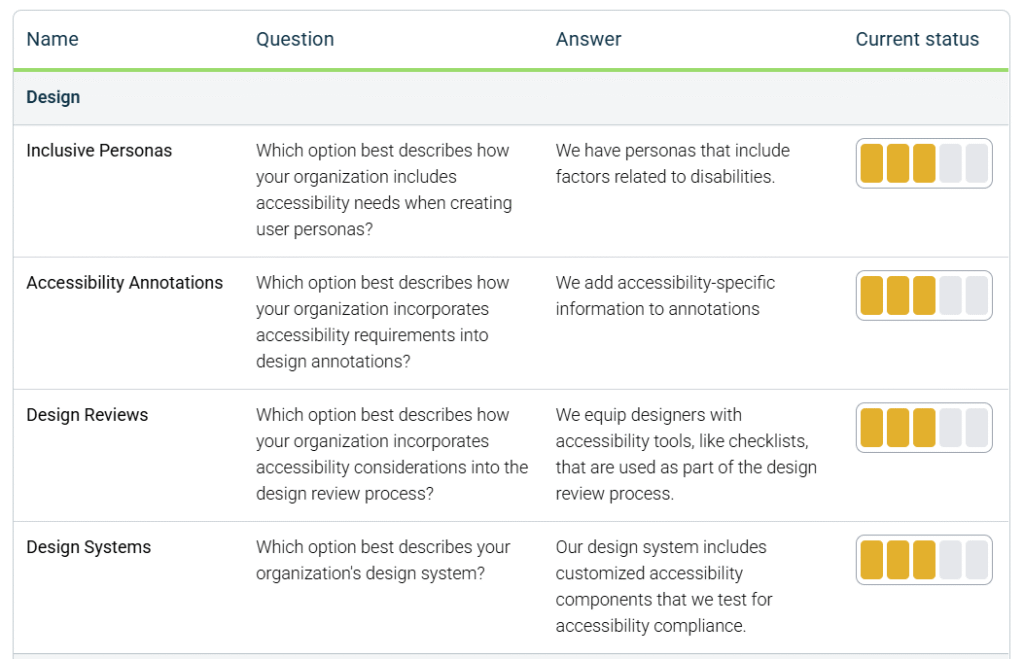
Les questions sont classées par thèmes, notamment la conception, le développement, les tests et la formation. Votre rapport proposera des mesures concrètes et spécifiques à mettre en œuvre pour vous accompagner dans votre parcours vers la maturité en matière d'accessibilité numérique.
Le processus est rapide et simple : il vous suffit de répondre à une série de questions en choisissant les réponses qui reflètent le mieux l'état actuel de votre programme d'accessibilité. En quelques minutes, vous recevrez une feuille de route claire et concrète que vous pourrez utiliser pour intégrer l'accessibilité à vos processus de travail, améliorer votre efficacité et réduire le temps et les ressources nécessaires aux tests et à la correction des défauts.
Mieux encore, votre plan s'appuie sur vos atouts existants, met en évidence les opportunités et recommande des mesures concrètes pour intégrer l'accessibilité numérique dans l'ensemble de votre organisation. Un plan véritablement applicable ne se contente pas de souligner les lacunes ; il met en avant les opportunités.
Donner un nouvel élan à l'accessibilité numérique
L'essence même d'un bon plan réside dans sa cohésion stratégique. Pas de cloisonnement. Pas d'incohérences. Pas de lacunes. L'objectif est que tous les éléments fonctionnent en harmonie, chaque étape menant naturellement à la suivante et créant une dynamique qui se renforce à tous les niveaux de votre organisation.
Examinons un exemple concret où une seule action délibérée peut déboucher sur des résultats très positifs.
Un exemple concret : les annotations d'accessibilité dans la conception
L'un des domaines sur lesquels cet outil met l'accent est la conception. Par exemple, il vous sera demandé comment votre organisation intègre les exigences d'accessibilité dans les annotations de conception.
Supposons que votre équipe de conception fournisse déjà des annotations destinées à guider les développeurs sur des aspects tels que la taille des boutons, les couleurs et l'espacement, mais qu'elle n'inclue pas d'informations spécifiques à l'accessibilité. Votre réponse tiendrait compte de cette situation, et votre plan sur mesure proposerait des mesures stratégiques visant à faire évoluer vos pratiques de conception.
Il pourrait, par exemple, vous recommander d'ajouter trois types spécifiques d'informations relatives à l'accessibilité à vos futures annotations. Ce petit ajustement peut avoir un effet d'entraînement positif :
- Les développeurs sont moins souvent confrontés à des questions d'accessibilité en cours de sprint et peuvent ainsi développer des fonctionnalités plus rapidement.
- Les équipes d'assurance qualité disposent ainsi d'une feuille de route claire pour les tests, ce qui réduit les ambiguïtés quant aux éléments à valider.
- Les responsables produit disposent d'une documentation réglementaire intégrée, ce qui leur évite de devoir se démener à la dernière minute.
Grâce à ce seul changement ciblé, votre organisation gagne en efficacité, réduit les risques et accélère la mise en œuvre. Et ce n'est là qu'un exemple parmi d'autres, issu de l'un des domaines thématiques de l'outil.
Tirer parti de vos points forts
Les annotations relatives à l'accessibilité ne constituent qu'un des nombreux domaines d'opportunité que nous avons identifiés. Chaque organisation dispose d'atouts inexploités et de domaines dans lesquels elle excelle déjà, qui peuvent être optimisés pour avoir un impact encore plus important.
Certaines équipes se rendent compte que leur système de conception est leur arme secrète. D’autres constatent que leur processus de test est la clé de l’accélération. L’outil « Plan d’action pour l’accessibilité numérique » mettra en évidence ces opportunités à forte valeur ajoutée et proposera des prochaines étapes stratégiques, vous permettant ainsi de les mettre en œuvre immédiatement.
Votre plan sur mesure sera élaboré en fonction de vos pratiques actuelles. Que vous partiez de zéro ou que vous souhaitiez développer des initiatives déjà bien établies, votre plan s'adaptera à votre situation actuelle.
Se lancer, mettre en place une structure, intensifier les efforts
La mise en place de stratégies concrètes permettra de réduire les obstacles tout en vous aidant à faire progresser vos pratiques en matière d'accessibilité, de la phase de démarrage à celle d'optimisation, en passant par l'organisation.
Si votre organisation en est encore aux prémices de son parcours vers l'accessibilité numérique, vous pourriez être confronté à des défis tels que :
- Corrections ponctuelles apportées par différentes équipes
- Des processus de travail inefficaces ou coûteux
- Absence de politiques cohérentes ou de formations adaptées aux différents rôles
- Incertitude concernant les obligations de conformité
Ces défis sont bien réels, mais ils peuvent être surmontés grâce à une approche plus structurée, à la fois réfléchie et proactive. Par exemple, vous pouvez :
- Intégrer des listes de contrôle relatives à l'accessibilité dans les processus de conception et de développement.
- Commencez les tests plus tôt dans le cycle de développement.
- Mettre en place des formations adaptées à chaque poste, en fonction des outils utilisés et des responsabilités.
- Sensibiliser aux risques liés à la conformité, notamment en ce qui concerne des réglementations telles que l'EAA, l'AODA et l'ADA.
À mesure que vous gagnerez en proactivité et que l'accessibilité numérique sera intégrée à vos systèmes et à vos processus, vous serez en mesure d'optimiser vos solutions non seulement pour garantir la conformité, mais aussi pour gagner en évolutivité, en rapidité et en impact à long terme.
Succès
Pour réussir à étendre l'accessibilité numérique à grande échelle, il faut passer d'une approche réactive à une approche proactive à l'échelle de l'organisation. Cette transformation commence par un plan — et aujourd'hui, l'élaboration de ce plan est plus rapide et plus simple que jamais.
L'outil « Plan d'action pour l'accessibilité numérique » vous propose une feuille de route claire et concrète qui s'appuie sur vos points forts, affine vos priorités et génère des résultats mesurables.
C'est le moment idéal pour commencer à adopter une conception et un développement accessibles, d'autant plus que l'EAA définit la prochaine ère de l'accessibilité numérique.
Prêt à vous lancer ? Il suffit de répondre à quelques questions pour élaborer votre plan d'accessibilité numérique. Commencez dès maintenant : https://accessibility.deque.com/action-plan