The global digital accessibility community is experiencing a time of incredible momentum and incredible urgency. From every corner of the world, we are seeing new stories emerge—regulatory expansion, technological innovation, groundbreaking legal decisions, and more.
This is happening at a time when AI is dramatically reshaping what it means to create digital products, services, and experiences. Our entire digital universe is being created and recreated at previously unthinkable speeds. Amid this transformation, the accessibility community has, of course, been concerned about whether digital accessibility can keep pace.
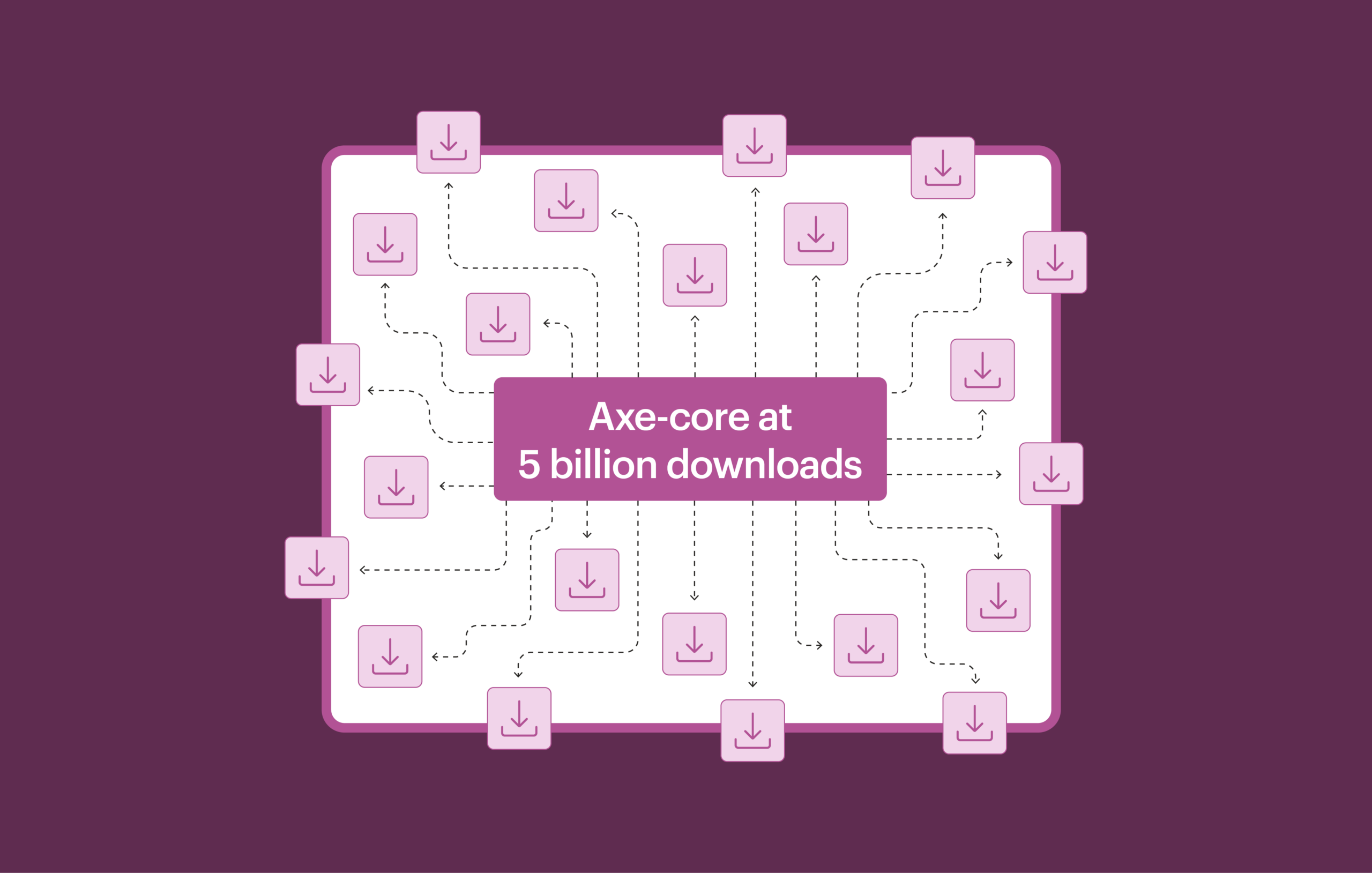
With that in mind, I am elated to share that Axe-core has just surpassed 5 billion downloads! It’s a remarkable number, made all the more so by the fact that it was only a year ago that we were announcing 3 billion Axe-core downloads.
At that point, the European Accessibility Act (EAA) was the hot topic in the accessibility community, having come into effect only weeks earlier. Today, the EAA is no longer the new kid on the block. It has transformed from concept to practical reality, with enforcement being more tangible and more tactical every day.
At the same time, updates to EN 301 549 are underway. While in Canada, the Accessibility Commissioner’s new 2025–2026 Annual Report makes it clear that Canada is entering a new phase of enforcement. The Australian Human Rights Commission recently affirmed WCAG 2.2 Level AA as its minimum benchmark. The Securities and Exchange Board of India (SEBI) is now enforcing ICT accessibility requirements for digital financial services. In South Korea, new amendments to the Disability Discrimination Act and the Digital Inclusion Act focus on digital accessibility across everything from websites and apps to kiosks and video content.
The global pace is accelerating, and it’s exciting!
Speaking of pace, we’re currently seeing nearly 10 million Axe-core downloads a day, which is a more than threefold increase since last year! It’s an amazing testament to the fact that over a decade later, open source still matters. That fateful decision to release Axe-core as an open-source accessibility testing engine in June 2015 is still reverberating, and it’s gratifying to know that focus on accessibility concerns is keeping pace with the velocity increases we see everywhere else.
We can also speculate about AI’s role in these trends. We know the use of AI agents is increasing, and that AI will often use Axe-core when prompted to make something accessible. If this is the case, it’s a good reminder about the importance of teaching your agents to do accessibility right, and to not rely on Axe-core alone. As we consider the meaning of this new milestone, we must understand Axe-core’s evolving role.
I am very grateful for this opportunity to pause and reflect. It’s not something I get to do very often. Like all of us in the accessibility community, there is truly no rest for the weary, and there remains so much to be done. But reflection helps to put things in perspective. In that spirit, I want to share a photo with you. It was taken in the Deque office in Ann Arbor, Michigan, back in 2018, when we met to celebrate the first one million downloads of Axe-core. There were lots of smiles that day, lots of high fives, and we probably all ate one too many Deque-branded cupcakes!
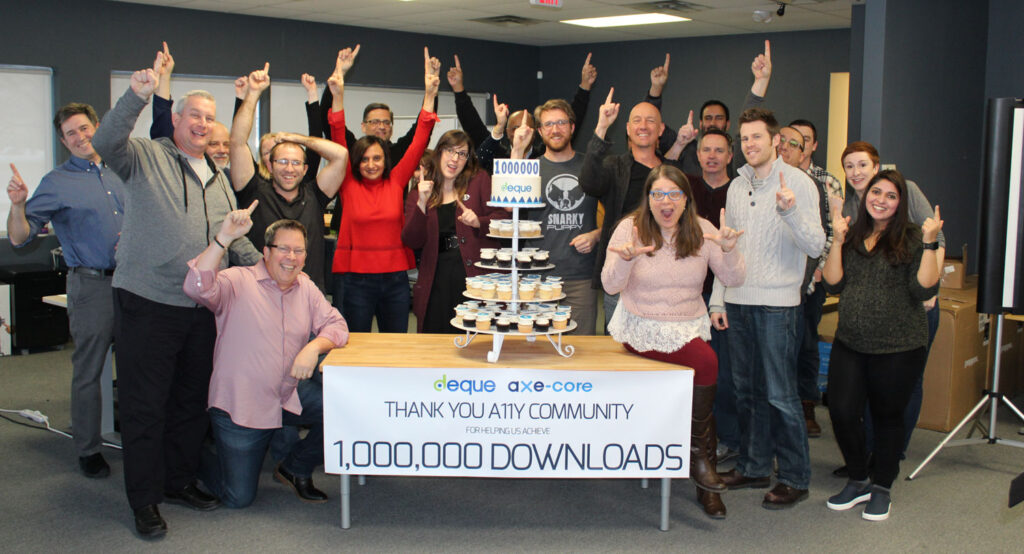
That was a big milestone, and the message on the sign is just as meaningful now as it was then: Thank you accessibility community! Deque CTO Dylan Barrell’s words at the time also still very much apply today: “The acceleration and wide adoption of Axe-core over the years is really a testament to the hard work of our contributors.”
Those are well-chosen words. It is hard work. While technology continues to make more things possible, it doesn’t necessarily make things easier. The reality is that technology has a knack for creating as many new problems as it solves.
In many ways, this is the world we find ourselves in today. AI is solving so much, but it is also creating new risks. So it is incumbent upon us all to ensure this transformational technology is harnessed as a force for good, and a force for digital inclusion. We can do this.
As I reflect on these Axe-core numbers, that is where my mind and my heart go—toward optimism. Because I see evidence everywhere that people are thinking about accessibility, that they care about accessibility, and that they believe accessibility matters.
Axe-core is, of course, not the entire answer. It’s a great baseline for accessibility, but it doesn’t make you accessible. For that, you need purpose-built tools and manual testing. Achieving accessibility compliance is a larger process. But ultimately, it’s not really about the number of downloads after all. It’s the energy behind those downloads. That’s what we’re celebrating today. Because every time someone downloads Axe-core because they want to make something accessible, that’s one more step toward achieving our mission of digital equality.