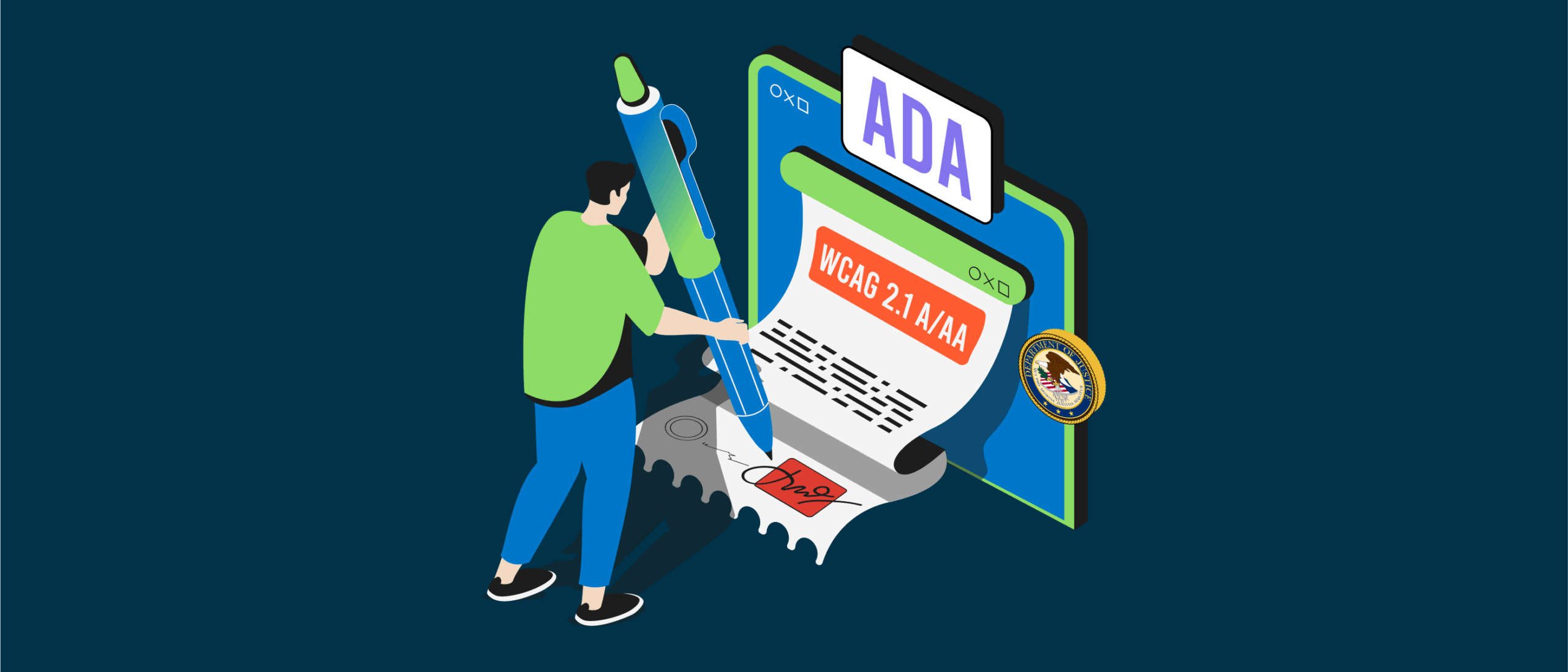
Je suis ravi d’apprendre que le ministère américain de la Justice vient de publier un avant-projet de règlement définitif visant à améliorer l’accessibilité des sites web et des applications mobiles pour les personnes en situation de handicap. La loi américaine sur les personnes handicapées (Americans with Disabilities Act, ADA) stipulait déjà clairement que les sites web américains devaient être accessibles, mais elle ne précisait pas exactement comment évaluer cette conformité. Ce nouveau règlement précise que la norme technique en matière d’accessibilité numérique applicable au titre II de l’ADA est la version 2.1 des WCAG, niveaux A et AA. Le Titre II de l’ADA concerne principalement les sites web et les applications mobiles des administrations locales et des États américains.
Cette nouvelle réglementation américaine s'inscrit parfaitement dans la lignée de l'engagement de longue date d'Dequeen faveur de l'égalité numérique. Les experts d'Dequeont collaboré étroitement avec les décideurs politiques, les leaders du secteur technologique et le W3C afin de contribuer à l'élaboration des WCAG 2.1, une norme pragmatique qui définit de manière objective comment évaluer les exigences minimales en matière d'accessibilité des expériences numériques.
Avec cette nouvelle loi, je suis sûr que vous vous posez des questions, et nous avons les réponses.
- Cette nouvelle loi américaine s'applique-t-elle directement à moi ? Le titre II de l'ADA et cette nouvelle loi concernent spécifiquement les collectivités locales et les États américains.
- Cette nouvelle loi américaine s'applique-t-elle indirectement à moi ? Oui, si vous êtes un site .com, .gov, .edu ou .org accessible au grand public américain (à l'exception des entités religieuses et des clubs privés).
- Bien que cette nouvelle loi porte principalement sur le Titre II de l’ADA, l’ADA dans son ensemble est une loi très large en matière de droits civils qui interdit la discrimination à l’encontre des personnes en situation de handicap dans les domaines de l’emploi, de la conception architecturale, des transports, des examens et des formations, ainsi que dans d’autres services ouverts au public. Le ministère américain de la Justice a clairement indiqué que l’ADA s’applique à toutes les organisations américaines (à l’exception des entités religieuses et des clubs privés). Voici quelques exemples concrets :
- Y a-t-il des exceptions concernant le contenu ? Oui, les exceptions concernent notamment le contenu web archivé, les documents traditionnels préexistants, certains contenus provenant de tiers et les publications préexistantes sur les réseaux sociaux.
- De combien de temps dispose-je pour me conformer aux normes WCAG 2.1 niveaux A et AA ? Les administrations locales et les États américains disposent de deux ou trois ans pour se conformer à cette exigence, en fonction de leur population.
| Taille des administrations des États et des collectivités locales aux États-Unis | Date d'entrée en vigueur |
| 0 à 49 999 personnes | 26 avril 2027 (3 ans après la publication de la règle)* |
| Collectivités locales spéciales | 26 avril 2027 (3 ans après la publication de la règle)* |
| 50 000 personnes ou plus | 24 avril 2026 (2 ans après la publication de la règle)* |
* Cette règle a été publiée au Journal officiel fédéral américain le 24 avril 2024.
Pourquoi Deque est-il particulièrement bien placé pour vous accompagner dans la mise en œuvre de ces nouvelles exigences ?
- Nos experts ont participé à la rédaction des directives WCAG 2.1 niveaux A et AA.
- Nous disposons d'une expérience concrète et pratique en matière de tests de conformité aux WCAG 2.1 niveaux A et AA depuis juin 2018 (date à laquelle les WCAG 2.1 ont été finalisées).
- En réalité, Deque a commencé à effectuer des tests de conformité aux normes WCAG 2.1 A/AA avant même que celles-ci ne soient finalisées, car nous nous sommes portés volontaires pour mener une démonstration de faisabilité visant à mettre en œuvre les normes WCAG 2.1 A/AA afin de nous assurer qu'elles étaient réalisables.
- Deque University vous offre tout ce dont vous avez besoin pour comprendre comment concevoir, développer et tester vos sites conformément aux normes WCAG 2.1 niveaux A et AA.
- Enfin, Deque est un pionnier des tests automatisés d’accessibilité numérique depuis plus de deux décennies. Deque est surtout connu pour son produit phare, « axe », une suite d’outils qui s’intègre en toute fluidité dans les workflows de développement, de contenu et de gouvernance. Conçue sur une plateforme commune, elle garantit cohérence et précision là où cela compte le plus. La suite « axe », qui comprend des outils de surveillance, de tests interactifs basés sur l’IA et de tests automatisés, s’intègre facilement dans les workflows numériques actuels, rendant ainsi l’accessibilité efficace et évolutive tout au long du cycle de vie du développement logiciel.
Grâce à notre expertise en matière de normes d'accessibilité numérique, associée à notre gamme d'outils et de services conçus pour garantir la conformité aux directives WCAG 2.1, nous sommes déjà parfaitement préparés à vous aider à respecter ces nouvelles normes et, si vous le souhaitez, à aller au-delà.
Nous considérons cette règle non seulement comme une validation de la voie que nous avons suivie, mais aussi comme un appel à l'action lancé à l'ensemble des organismes gouvernementaux américains (.gov) afin qu'ils accordent la priorité à l'accessibilité et à l'inclusion pour tous.