There’s a new deadline looming for the Accessible Canada Act (ACA), and it’s a significant one. From here, it may still look far away. But the work required to meet the new requirements is substantial. It will require a sequential effort with many steps, and you need to start now if your business is going to safely meet the new deadline. Previously, you were required to develop, commit to, and publish a plan. Now, you have to actually deliver against that plan.
The process should begin with self-assessment: where does your organization currently stand, where are the gaps, and what actions should you prioritize? In this post, I’ll share a five-question framework you can use to self-assess, and provide you with some clear next steps you can take today.
But first, let’s make sure we’re clear on deadlines and expectations.
Understanding the new deadline
Last year, the Accessibility Commissioner found 95 organizations non-compliant. The issues were wide-ranging. Some organizations published their accessibility plan in a format people with disabilities could not read. Some took their documents down early, before the seven-year retention period was up. Some named barriers without detailing what they intended to do about them, making progress impossible to verify.
This all took place before December 5, 2025, when Canada added a new requirement: technical evidence. What you tested. What you found. What you bought. Who you trained. Where you still fall short, in writing, on your own website.
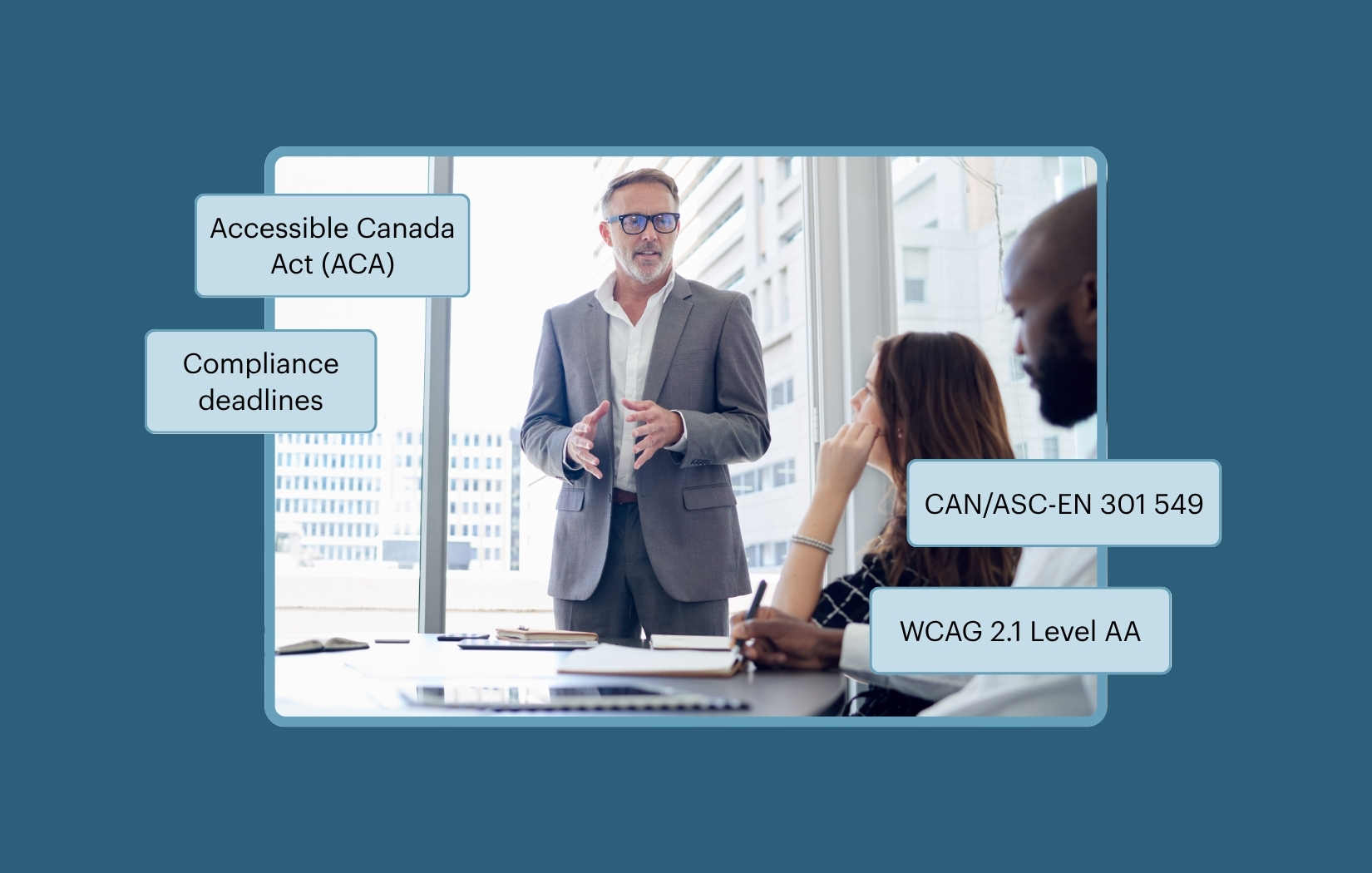
That’s what the new compliance deadlines are all about, as detailed below:
- December 5, 2027. Federal public sector organizations have to have their accessibility statement published, their web page conformance in effect, and the first round of training finished. Training must be completed that day for federally regulated businesses with 100 or more employees.
- December 5, 2028. Web page requirements reach businesses with 100 or more employees. Mobile apps, digital documents, accessibility statements, and procurement requirements reach the federal public sector and businesses with 500 or more employees.
Note: Transportation providers, broadcasters, and telecommunications entities are exempt from some of these requirements, and the exemptions are drafted differently from one provision to the next. If you operate in one of those sectors, get your determination in writing before you build a plan around it.
Five reasons why the urgency is real
As I mentioned above, compliance is a multi-step process. Let’s explore why.
- The statement is the last step, not the first. To write a public disclosure, you have to first test, prioritize fixes, and commit to dates. It’s a chain of actions, and the deadline lands on the last link. You need lead time to get there.
- Conformance starts the day the rule starts. The new requirements apply to pages you create or update on or after the deadline. On day one, you must be producing conformant output. That means your design system, components, authoring practices, and QA gates must be adapted and ready months before the deadline hits.
- The first round of training has to be completed, not started. Every single person who builds, maintains, or buys technology—across engineering, content, and procurement—has to have been trained by the deadline, and you’ll need the records to prove it. The requirement also states that refresher training must be completed every three years. Standing up a new training program is hard work in itself and takes time. Ensuring everyone actually completes the training is all the more challenging. You’ll need to set aside several quarters for this effort.
- Get accessibility requirements into your procurement contracts now. Starting December 5, 2028, federal public sector entities and private sector entities with 500 or more employees must obtain a conformity assessment with gap analysis when initiating a procurement for products or services connected to a regulated web page or mobile application. The requirement attaches to the procurement action, not to products already in place. But the regulation doesn’t obligate your vendors to hand you an assessment. Your contract language does. Procurement templates take months to revise and even longer to become default practice.
- Your next progress report is the first draft of your accessibility statement. Your progress reports are public, and your accessibility statement will be public. If the barriers in one do not match the gaps in the other, it will be clear to anyone who reviews them. It’s essential that your plans, progress, and proof tell the same story.
These requirements sit under the Accessible Canada Act. The rules are formally called the Digital Technologies Accessibility Regulations, and they add a new part to the Accessible Canada Regulations covering websites, mobile apps, and digital documents.
The technical standard is CAN/ASC-EN 301 549. For web content, that means WCAG 2.1 Level AA. If your organization is also subject to Ontario’s Accessibility for Ontarians with Disabilities Act (AODA), this is the same target you have been aiming at since 2021.
The five-question self-assessment framework
Getting started means assessing whether your current accessibility program is ready for greater regulatory scrutiny and identifying any gaps in governance, testing, procurement, and reporting. That is why it’s critical to start now. You can use the five-question self-assessment I share below as a kind of diagnostic trigger. It’s not a solution, but it’s a simple, practical way to surface the information you need right now.
Once you’ve identified the issues, you can assess how serious they are and determine what to do about them. That’s where Deque comes in. We’re here to absorb and interpret those diagnostic results and build a path to compliance with you.
As you work through these, you’ll see that each of these questions has a required document behind it—a record the Commissioner can ask you to produce, with a retention period attached.
1. Can you produce the accessibility conformity assessment?
Your obligation is conformance to the standard CAN/ASC-EN 301 549. An assessment with a gap analysis is how you demonstrate conformance. You must retain the report in electronic form for four years after completion.
One additional item to note: If you continue to offer a downloadable app that launched before your deadline, you still owe an assessment on that app, even though the conformance requirement itself only applies to apps launched later.
To get started, ask your team which properties have a current, documented gap analysis. And remember, an automated accessibility scan is not a full assessment!
Required documentation: A conformity assessment with gap analysis that must be kept for four years.
2. Does procurement produce an accessibility gap analysis, or just ask a question?
For the federal public sector and for businesses with 500 or more employees, the rule states that when you buy products or services for a website or app you are responsible for, you must obtain an accessibility conformity assessment with a gap analysis as part of that purchase.
Most procurement templates do not do this. A vendor questionnaire is not a gap analysis. Neither is a vendor’s Accessibility Conformance Report (ACR) on its own.
The Accessibility Commissioner of Canada’s 2025–2026 Annual Report provided very clear guidance about this:
“Put formal measures in place that require your vendors and third-party providers to meet or exceed your accessibility standards, so your clients consistently receive accessible products and services.”
One additional note here: CAN-ASC-4.1, the draft Canadian standard for accessible procurement, is expected to be published in the winter of 2027. It is voluntary until written into regulation, so build your process around the ACA rule that is already law.
Required documentation: A procurement conformity assessment with gap analysis that must be kept for four years.
3. Are your accessibility barriers connected to actions that will fix them?
The key here is the need to go through every barrier in your plan and ask three things: 1) What did we do about this one? 2) Where does it stand today? 3) Who owns the work that remains to be done?
This is an issue the Commissioner has flagged for two years running—the gap between identifying and testing a barrier and actually fixing the issue and removing the barrier. If a reader cannot follow a specific barrier to the specific work that addressed it and understand where things stand now, then, from the outside, there is no progress.
Your accessibility statement lists where your digital properties fall short, and your progress reports describe what you’ve been fixing. Both are public and need to say the same thing.
Required documentation: Your accessibility plan and progress reports, which must be publicly available for seven years.
4. Can you prove who was trained on accessibility, and when?
Everyone involved in building, maintaining, or buying technology has to have been trained on accessibility fundamentals by the deadline. They’ll also need to have a refresher at least every three years. And, you have to keep an electronic record of all training activities for four years.
Training should therefore be understood as an ongoing concern, not a single milestone. You need to be able to prove it on any given day, for anyone on that list—and that includes everyone from the developer who just joined the company last month to the procurement officer who almost slipped through the cracks.
To get started, take two questions to HR and engineering: 1) Who needs to be on the list? 2) How will you produce a dated training record for each of them?
Required documentation: Training records for every relevant employee that must be kept for four years.
5. Are you ready to publish your own gap list every year?
Federal public sector organizations and businesses with 500 or more employees must publish an accessibility statement by their deadline and refresh it annually. In plain language, it must acknowledge your obligations, provide two ways to contact you about accessibility, and describe your accessibility features. It must also list where you are not meeting the standard, explain the resulting barrier, and give your plans and timelines for closing the gaps. The statement must be easy to find from every page it covers. Remember, your customers, your competitors, and the people evaluating your bids can all read it.
Required documentation: A published accessibility statement, refreshed every twelve months, with a copy that must be kept for four years.
Governance and the business case for compliance
As you review the required records detailed above, it should be clear that they all have one thing in common. Every one of them expires. Assessments go stale. Training refreshers come due every three years. Statements need republishing every year. Plans and progress reports have to stay posted for seven years.
You could literally satisfy all five requirements in 2027, and then find yourself non-compliant in 2029—without changing a thing! That is the case for governance, and it’s not just a compliance case. It’s a cost case.
Organizations without governance pay for accessibility over and over. Every deadline is a scramble. Every audit is a surprise. Every release ships bugs that a component library would have prevented, and every one of those bugs gets found late, by a customer or a regulator, when it is most expensive to fix.
Organizations with governance pay once and get compounding returns. When you fix a pattern in your design system, every page built on it inherits the fix. Put conformance criteria in your procurement template, and the market absorbs the work. Train the people who write and build, and new defects stop arriving. Your first assessment will cost what it costs, but your third will only need to be a spot check, because you’ll already know your gaps and who owns them.
Compounding progress happens everywhere. Your assessments populate your accessibility statement. Your statement lines up with your progress report. Your training log has the answers before any questions even get asked.
Most importantly, governance is what turns a compliance date into a product that actually works for your customers.
Prochaines étapes
As we’ve now established, the required work is sequential and time-consuming, and next year’s deadlines aren’t so far off after all. Fortunately, there are two steps you can take right now that will make everything else doable.
First, get your scope determination in writing. Understand which rules apply to you, based on your organization type, your employee count, and your sector. This determination drives your timeline and your budget. This is the step most often skipped, and everything below depends on it.
Second, get one real assessment. Not just an automated scan. An accessibility conformity assessment with a gap analysis on a digital property that matters. That single document will tell you what your remediation will actually cost for that property. It will seed your accessibility statement and give you the budget number you need to ask for.
From there, the order is straightforward. Inventory what is in scope. Rewrite your procurement template before you sign the next contract. Stand up training with records that hold up. Then, draft an accessibility statement you would be willing to publish, and treat the distance between that draft and the truth as your backlog.
This is all necessary work, and it’s a lot of work. But here’s the good news. If you want a partner, this is what Deque does. We help you sort out which requirements apply. We run the assessments and build the gap analyses. We train your teams and help you reach a statement you’re comfortable publishing.
Schedule your strategic consultation today, and we’ll dial in the right plan for your organization.