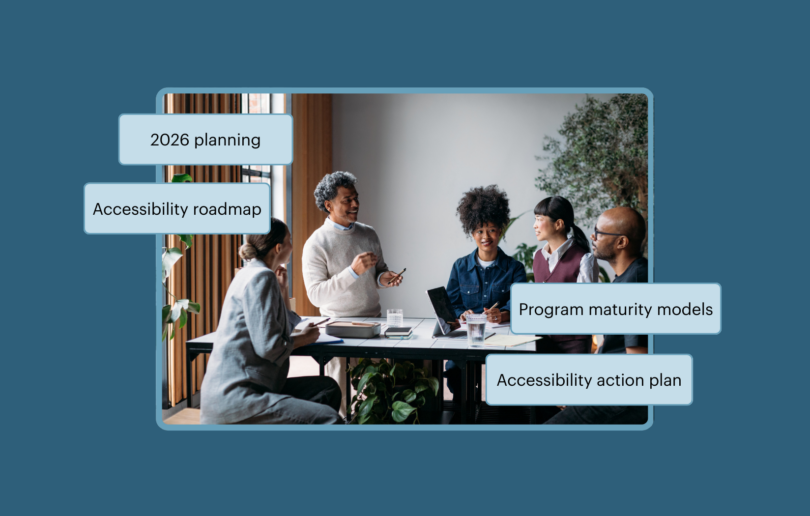

Building an accessibility program is key for maintaining a culture of accessibility in the workplace. It also ensures that accessibility is scalable and cost-effective. Depending on your organization, an accessibility program can be centralized or decentralized.
In a centralized accessibility program, or “hub and spoke” model, the responsibility of accessibility falls to a single group within the organization– accessibility management does not fall to each individual business unit. The inverse is true for a decentralized accessibility program, i.e. accessibility management falls to each individual business unit.
In today’s post, we will discuss the advantages and disadvantages of each program type below.
Centralized Accessibility
A centralized accessibility program manages both the accessibility testing and operational components of accessibility in one unit. Oftentimes, organizations that are large/enterprise and compliance-driven choose this approach.
In practice, I’ve observed that our clients’ centralized programs commonly sit under their Digital/Digital Experience/Digital Transformation divisions. In some cases, the program sits under Legal and Compliance. These programs are generally not under IT (web experience).
Advantages
One major advantage of this approach is that accessibility testing can be measured and tested in one location across all of the businesses properties, which yields consistent results. It is also much easier to measure and assess the risk of accessibility in a centralized model. Finally, when accessibility is centrally managed, it is much easier to gain buy-in and funding from the executive team to make the accessibility program sustainable.
Disadvantages
One disadvantage of this approach is that it can be difficult to embed accessibility as a cultural best practice at the grassroots level. Content owning teams may feel that accessibility is a burdensome requirement being implemented from above, and, as a result, are less motivated to proactively address accessibility.
Additionally, a centralized approach towards accessibility can create a layer of bureaucracy or a bottleneck that makes it difficult to quickly implement or change accessibility features at the product level.
If your organization chooses the centralized approach, it’s important to focus on a strong policy that governs the software development lifecycle. It’s critical to have an executive mandate that supports this governing policy.
Decentralized Accessibility
A decentralized, or distributed, accessibility program often works for small organizations as it provides high-touch management of product accessibility. From our clients’ case studies, I’ve observed that decentralized accessibility programs commonly sit under IT.
Advantages
This approach works very well when grassroots roles, such as developers or designers, care deeply and are well-trained around the topic of accessibility. This approach is also very advantageous for organizations that need to respond quickly to their customer’s needs for individual products.
In a centralized approach, it is very important to have a strong governing policy for accessibility. However, in a decentralized approach, developers and designers proactively want to implement accessibility so it doesn’t disrupt their product development cycle down the line.
Disadvantages
As previously mentioned, it can be difficult to consistently test and measure for accessibility across multiple business units or teams. Oftentimes, a decentralized model can give the false appearance of low risk; however, the risk is actually spread out over multiple business units.
Decentralized accessibility programs can also struggle to get executive buy-in. The distribution of effort makes budgeting and accountability more complicated, and it can be more challenging to present a clear, unified course of action.
Zusammenfassung
It goes without saying that both centralized and decentralized accessibility programs have their advantages and disadvantages. The most important factors that will influence this decision should be your organization’s size, need for rapid product change, or governing policy around accessibility. Whichever program your organization chooses, structured accessibility programs are a great way to scale implement a cost-effective approach to accessibility.