

Study Commissioned by Deque Systems Finds 70 Percent of Internet Websites in Certain Industries Inaccessible to the Vision-impaired, Missing a $6.9 Billion Market
HERNDON, VA – August 15, 2019 – Deque Systems, a leading accessibility software company specializing in digital equality, today announced the results of a study conducted by Nucleus Research showing a pervasive “digital divide” for blind persons accessing the internet, as well as a missed market opportunity for the websites in question.
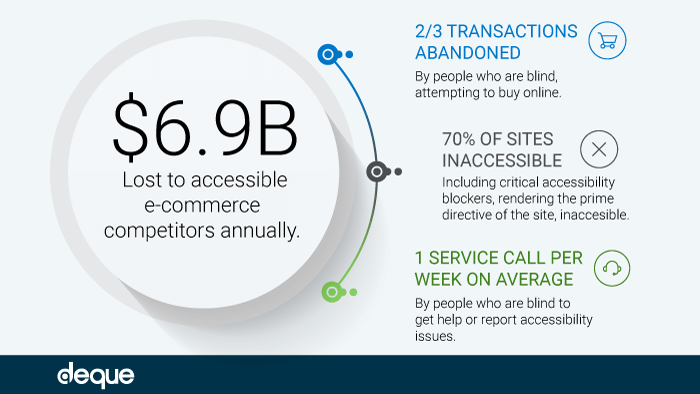
The study, which conducted in-depth interviews with 73 U.S. adults who are blind or have severe visual impairments, revealed that two-thirds of the Internet transactions initiated by people with vision impairments end in abandonment because the websites they visit aren’t accessible enough. Ninety percent of those surveyed said they regularly call a site’s customer service to report inaccessibility and have no choice but to visit another, more accessible site to make the transaction.
The Nucleus study also scanned hundreds of websites in the e-commerce, news and information, and government categories and found that 70 percent had certain “critical blockers” that rendered them inaccessible to visually impaired users.
“Besides the moral dilemma and legal risk, businesses with inaccessible websites are missing a huge revenue opportunity by ignoring an untapped market,” says Preety Kumar, CEO of Deque Systems. “Among internet retailers specifically, two-thirds of the top ten online retailers had serious accessibility issues, meaning they are leaving $6.9 billion in potential North American e-commerce revenues on the table.”
Web accessibility refers to the ability of people with disabilities to independently gather information, complete transactions, or communicate on the Internet. Most visually impaired Internet users rely on assistive technologies like screen readers or screen magnifiers to render sites perceivable and operable. However, these assistive technologies require that websites be built with accessibility in mind and optimized to interface with assistive technology, in order to convey information in an accurate and understandable manner.
Critical accessibility blockers can vary across industries. In e-commerce, problems include issues like missing form and button labels (thereby making forms or the “checkout” button invisible without context). Amazon, Best Buy and Target were found to be accessibility leaders in this space. Additionally, the study found:
- Eight out of ten news sites had significant accessibility issues.
- Seven out of ten blind persons reported being unable to access information and services through government websites, including Medicare’s site.
- Fewer than one in three websites have clear contact information or instructions for blind persons to seek help if they encounter accessibility issues, meaning many have low levels of success in reporting and solving these problems.
“A focus on accessibility needs to be a core part of the website design and development process,” continues Kumar. “Considering accessibility as early as the conception phase, and proactively building and testing sites for accessibility as they move towards production, is significantly more effective than remediating it later, helping organizations save significant time and resources while avoiding unnecessary customer grievances.”
To download the report, visit: (This report is no longer available.)