
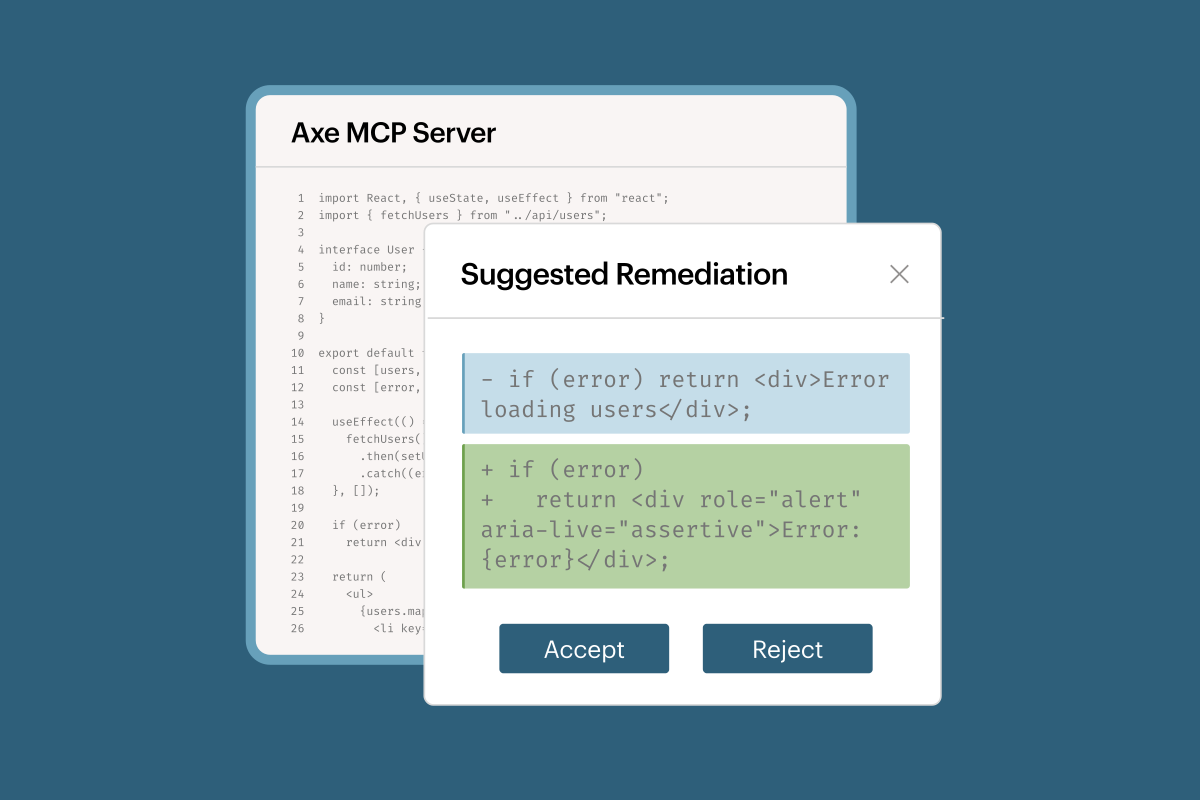
Accessibility remediation can be slow, expensive, and hard to scale. Deque has actively been working at changing that through Axe MCP Server—a Deque tool that brings Axe Platform expertise into AI coding agents. Deque’s team used the tool on client projects to prove that faster, more cost-effective remediation was possible, without compromising quality. The results made the case.
The challenge: The cost of manual remediation
Automated testing surfaces accessibility issues reliably. What happens next is where delivery timelines slip and costs compound. Each finding has to be interpreted, mapped to the right fix, and implemented correctly within a specific codebase and framework—by a developer who may not have touched that code in months, working in a stack that may have evolved since the last remediation cycle.
Across large applications, that translation cost adds up fast. Back-and-forth between identification and implementation drives repeated remediation cycles, longer timelines, and more effort than initial estimates account for. The question was simple: can accessibility remediation be reliably automated and scaled without compromising quality?
The solution: Bring accessibility guidance into developer workflow
The team introduced Axe MCP Server into customer remediation projects to find out. Rather than treating accessibility scan results as standalone reports for developers to interpret, it delivers actionable, framework-aware guidance inside the development environment—so coding agents can act on each finding and make actual source code fixes without leaving their workflow.
The tool proved especially effective for repeatable accessibility issues, where the solution pattern is well understood but the implementation varies across modern stacks like React, Vue, and vanilla JavaScript. For developers, this means freeing their time from interpreting the findings and instead jumping to implementing fixes. For organizations, it means faster resolution, fewer remediation cycles, and more predictable delivery timelines.
“Developers shouldn’t have to be accessibility experts to fix accessibility issues. Axe MCP Server gives them exactly what they need, exactly where they need it so they can just fix the problem.” — Dylan Barrell, CTO, Deque Systems
The impact: Accelerating remediation while reducing cost
Deque used Axe MCP Server on web remediation projects to fix accessibility issues identified through automated testing. The goal was to improve the speed and consistency of remediation while maintaining quality standards and the results delivered on that promise:
• 20–30% fewer hours on automated accessibility issue remediation with Axe MCP Server
• 30–40% fewer hours when the workflow extended to manually-found issues
• Projects delivered at two-thirds of the original estimated cost, with savings passed directly to the client
“Seeing 40% efficiency gains reinforced our belief that Axe MCP Server can fundamentally improve how accessibility remediation gets done.” — Sujasree Kurapati, Head of Services, Deque Systems
Perspectives d'avenir
For organizations working through accessibility remediation backlogs, the impact is already measurable: issues move from backlog to resolution faster, with fewer cycles of interpretation and rework. As automated testing coverage grows, so does the opportunity for Axe MCP Server to accelerate the work of fixing what’s found. Deque is continuing to evolve Axe MCP Server so that faster, higher-quality remediation becomes the expectation, not the exception.
If your team is carrying a remediation backlog or wants to get ahead of one, contact Deque to see how Axe MCP Server fits your workflow.
