What started nearly two decades ago as conversations between two people passionate about improving accessibility across Microsoft’s digital experiences has grown into a lasting partnership built on shared learning, mutual respect, and a common belief that accessibility should be built into every stage of software development.
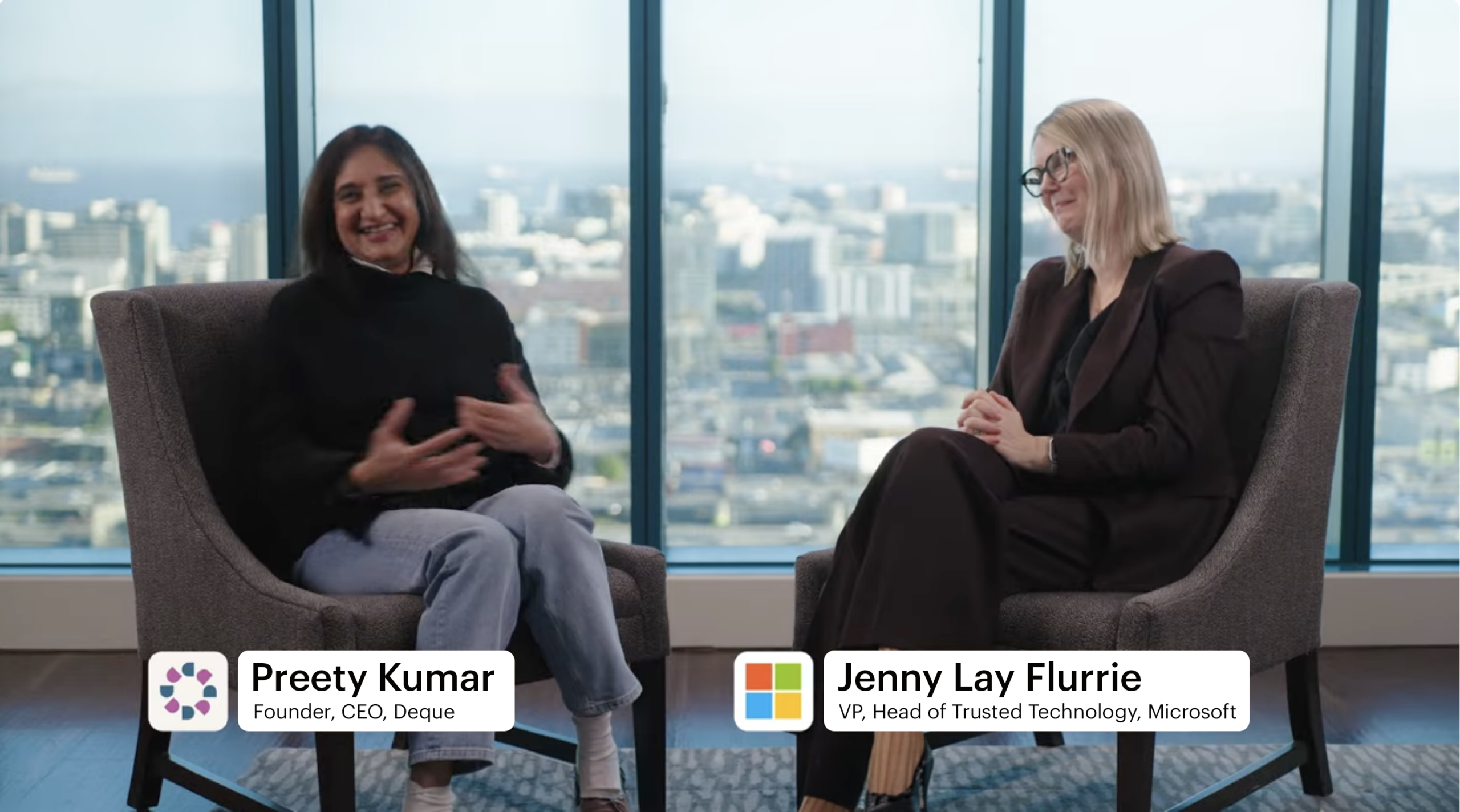
I recently had the opportunity to reflect on that partnership with Jenny Lay-Flurrie, who was, at that time, Microsoft’s Chief Accessibility Officer (she has recently assumed the role of Vice President, Head of Trusted Technology). We filmed a short video about our organizations’ work together. Watching it back, what stood out to me was not just the milestones, although there have been many. It was the relationship behind those milestones: a partnership built on trusting each other enough to ask hard questions, challenge assumptions, and think through problems together.
The next frontier: Artificial intelligence that starts with accessibility
My conversation with Jenny was not just about the past. We also talked about where accessibility can go next, especially as artificial intelligence (AI) continues to reshape how software is built.
Today, we are at a critical juncture. Regulation, AI transformation, and digital accessibility are converging, and it requires a new kind of response from accessibility and engineering leaders. AI has the potential to dramatically accelerate software development, but only if accessibility is built into those workflows from the very first prompt, not fixed after the fact.
As we’ve seen through our own research, when accessibility is fully embedded into AI-assisted development, organizations reduce costs, lower compliance risk, and improve software quality. More importantly, they build experiences that work better for everyone.
The disability community has been advancing human-computer interaction for decades. That expertise isn’t just important from an accessibility perspective. It’s technically essential for building AI systems that are more robust, more reliable, and ultimately more effective.
The future of accessible AI will be shaped by the practices we establish today. That is a challenge bigger than any one organization can solve alone. It is exactly the kind of challenge that requires collaboration, and it reminded me why our long partnership with Microsoft has been so meaningful.
Partnership as a way of thinking, not just a way of working
During our conversation, Jenny reflected on something that has defined our relationship over the years:
“There aren’t many people to have that depth of conversation, where you’re genuinely curious about solving a challenge together rather than simply trying to reach a deliverable.”
Her words resonated with me because they capture something that many people in the accessibility community experience every day. Technical integrations and shared projects matter, but they’re built on something deeper: trust, curiosity, and a willingness to learn from one another. The accessibility community has understood this for years: meaningful progress comes not only from technology, but from the relationships and shared commitment behind it.
In an industry where accessibility expertise is still unevenly distributed, it is vital that we act in concert as a community. Tools alone are not enough. We need the shared expertise and lived experiences of everyone together, so that we can determine what is and isn’t working and what we can achieve together.
Building momentum across the accessibility community
One of the clearest examples of where this collaboration has led is Axe-core, Deque’s open-source accessibility rules engine. Microsoft has built Axe-core into its own development and testing practices for many years, making automated accessibility checks a standard part of how its teams ship software.
That internal adoption didn’t stay internal for long. Today, Microsoft vendors and partners are regularly expected to meet the same accessibility standards Microsoft was holding itself to.
This is the impact of a company like Microsoft making accessibility a priority. When organizations with broad reach set expectations for accessible products and experiences, those expectations extend throughout the ecosystem.
We see organizations strengthen their accessibility practices because Microsoft sets clear expectations and because the tools and guidance exist to help teams meet them.
That is what collaboration can do. It can turn one organization’s commitment into momentum for an entire community.
Collaboration, not competition
Accessibility has never been a zero-sum game. Every time one organization makes the digital world more accessible, everyone benefits. That is why collaboration has always mattered more than competition in this space.
Digital accessibility does not move forward because one company or one tool solves the problem. It moves forward when organizations choose to build together, share what they learn, and invest in solutions that benefit the broader community.
That is the lesson I continue to believe in: Find peers who will challenge you. Build together. Share what you learn. Stay curious.
For teams looking to strengthen their accessibility efforts, start by asking one simple question: who are the partners, advocates, and experts you can learn from? Accessibility moves faster when knowledge is shared. Whether through open source communities, industry conversations, or collaboration with accessibility practitioners, every organization has an opportunity to contribute to a more accessible digital world. We’re proud that organizations like Microsoft partner with Deque on accessibility, and we’re grateful for the trust every single one of our customers puts in Deque to help ensure their products and services are accessible.
We have a rare opportunity to shape the future of software at the same time we’re shaping the future of accessibility. Let’s seize it. By embedding accessibility into AI from the start and continuing to learn from one another, we can build better technology and experiences for everyone. The need is urgent and the time is now.