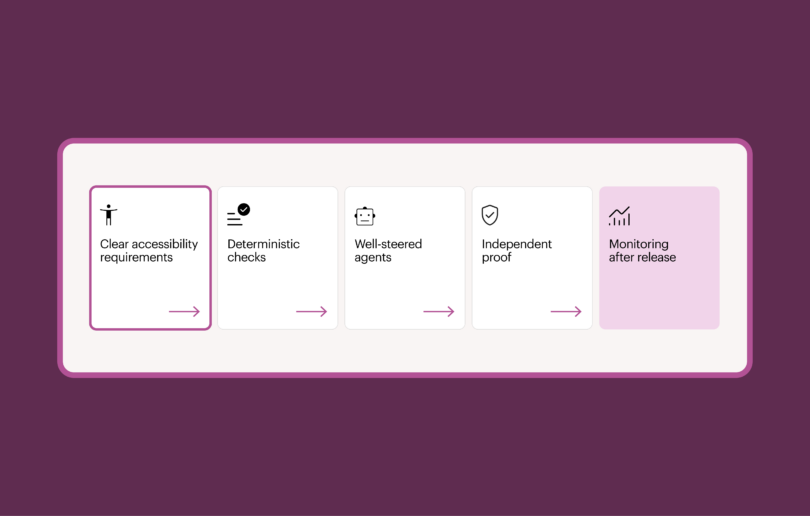
At Deque, we are working diligently toward a world where accessibility testing, fixing, and development require zero specialized knowledge—where any team, anywhere, can build accessible experiences effortlessly.
Artificial intelligence is a crucial factor in reaching this goal.
Today, automated testing covers 57% of accessibility issues by volume. This represents incredible progress. But we’re pushing this even further. At axe-con 2025, we are announcing new, AI-driven capabilities that address the toughest accessibility challenges—increasing test coverage, reducing manual work, and making accessibility testing faster and easier than ever.
New capabilities coming in 2025 include advanced rules, AI-assisted testing for Intelligent Guided Tests (IGTs), accessible coding with AI agents, and Axe Assistant for Slack and Teams.
Advanced rules: Smarter automation
We’re building on axe-core with a new ruleset powered by AI, advanced machine vision, and screenshots to detect accessibility issues commonly missed by traditional automation—all while upholding our commitment to zero false positives.
Automation, for example, can detect when an image lacks an alt attribute, but it can’t always determine if an empty alt is correct (e.g., a decorative icon) or an issue (e.g., a missing label on a button). Developers currently have to make that call manually.
By analyzing real-world data from thousands of audits, we’re closing these kinds of key gaps. Our initial release will increase automated coverage by up to 10% by volume—a major leap forward in accessibility test automation.
These advanced rules will first be available in the axe DevTools Extension.
To learn more, register for “AI Systems for Accessibility” at axe-con.
AI-assisted testing: Automating Intelligent Guided Tests
Intelligent Guided Tests (IGTs) can deliver 80% coverage by volume today, but they require costly manual effort—developers have to answer questions to help AI understand their application.
With our new testing approach, AI can run these IGTs automatically—analyzing pages, applying reasoning, answering questions, and delivering results with clear explanations. Developers can then accept, reject, or refine AI suggestions.
AI also makes re-testing faster by remembering past decisions. During regression testing, it flags only what has changed—reducing AI workload and keeping accessibility checks efficient.
To learn more, register for “Automation Gains: Increasing what can be automated in accessibility testing” at axe-con.
Axe Assistant: AI-powered guidance, where you work
Educating your teams is the best way to fix accessibility issues before they reach your customers. Coming soon to Slack and Teams, axe Assistant gives designers, testers, and developers direct access to Deque University’s trusted knowledge base, offering expert guidance without disrupting their workflow.
Axe Assistant provides real-time accessibility insights, whether working solo or collaborating in group chats, helping teams catch issues early. Developers can quickly check color contrast, generate accessible code, and simplify complex guidelines into plain language—all without leaving their workspace.
By embedding axe Assistant into the tools teams already use, we’re making accessibility easier, more intuitive, and always within reach.
Watch the following video to see axe Assistant for Slack in action.
Accessible coding with AI agents
AI coding agents are becoming a key part of the development workflow, allowing developers to generate, refine, and validate code with minimal manual effort. These agents work iteratively, taking instructions, producing results, gathering feedback, and improving their output until it meets the developer’s needs.
By connecting axe Assistant and axe Tools to AI coding agents, accessibility becomes an integral part of this process. Deque is the first accessibility company to support the emerging standard for integrating tools into AI agents—the model context protocol.
The agent will be able to pull in accessibility expertise whenever needed—asking axe Assistant for accessibility requirements, generating accessible code, and using axe Tools to validate and fix issues automatically. All of this happens seamlessly within the developer’s workflow, with the AI agent handling the heavy lifting while the developer stays in control.
The result? Faster, more accessible code without guesswork. Developers can focus on building great experiences, knowing that accessibility is built in from the start.
To learn more, register for “The future of the axe Platform” at axe-con.
Join us in shaping the future
We’re inviting our current customers to join our early access program for advanced rules, AI-assisted testing for IGTs, accessible coding with AI agents, and axe Assistant for Slack and Teams. Ready to be part of the next evolution in accessibility testing? Request access today!
If you haven’t already, register for axe-con right now to learn more about the new capabilities from the Deque team.