
CVAA – Communications and Video Accessibility Act
The CVAA applies to organizations that deliver web-based videos originally captioned on TV, and to manufacturers of Advanced Communications Services (ACS), Devices, Equipment, Connectors and Mobile Browsers.
What is a the CVAA?
CVAA or the Twenty-First Century Communications and Video Accessibility Act was enacted on October 8, 2010 to ensure that people with disabilities have access to the innovative communications technologies of the 21st Century. The CVAA mandates accessibility of public-facing communications that are regulated by the Federal Communications Commission (FCC).
Specifically, the CVAA covers four broad communications categories:
- Television and IP-delivered Video Programming
- Telecommunications Relay Services (TRS) & Emergency Communications
- Devices, Equipment, Connectors & Mobile Browsers
- Advanced Communications Services (ACS).
What does the CVAA mean for website owners?
If your organization delivers Web-based videos originally captioned on TV or if it manufactures or provides Advanced Communication Services (ACS) for the general public, you need an immediate action plan for each of the following content types:
- IP-delivered video content originally captioned on TV.
- Interconnected and non-interconnected voice over Internet protocol (VoIP) services.
- Electronic messaging services, including:
- Text messaging.
- Instant messaging/chat.
- Interoperable video conferencing services.
For online video, the CVAA extends closed captioning obligations to video programming provided by (or generally considered comparable to programming provided by) television broadcast stations, even when distributed over the Internet.
- The CVAA covers video programming previously captioned for television viewing, live video programming, and new video programming provided by or considered comparable to programming provided by multichannel programming distributors.
- The act also explores the need for online interfaces around the navigation of audiovisual interfaces to be accessible.
- The act does not cover user-generated content (e.g., YouTube videos posted by individuals).
Actionable steps to meet CVAA requirements
1. Identify which is the most heavily used audio-visual content and begin by making that material accessible.
2. Create a workflow so that any new material is captioned and made accessible.
3. Prioritize existing audio-visual assets. Ensure that any existing assets that are critical to individuals using your site are prioritized highly.
4. Test to make sure that the audio-visual players used to deliver content are accessible to users of assistive technology.
Weitere Ressourcen

Axe-con 2026
Die weltweit größte Konferenz zum Thema digitale Barrierefreiheit ist nur einen Klick entfernt. Sie ist kostenlos, findet virtuell statt und ist unglaublich gut.

Unverzichtbarer Leitfaden
Machen Sie sich mit dieser praktischen Sammlung von Statistiken und Definitionen mit den Grundlagen der Barrierefreiheit im Web vertraut.
Forrester Wave
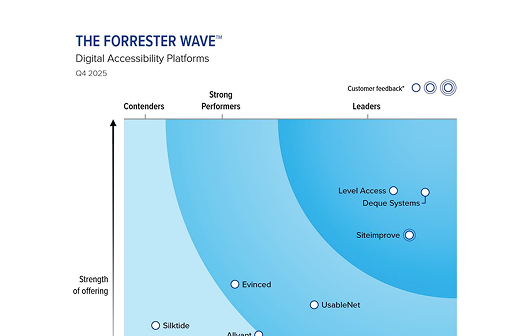
Deque in „The Forrester Wave™: Digital Accessibility Platforms, Q4 2025“ Deque führendes Unternehmen Deque .
